Entering CommunityIt is easier ... so much so, that I wonder if it isn't the predominant temptation of a certain kind of woman of a certain age. ;)
Jean Vanier
"When people enter community, especially from a place of loneliness in a big city or from a place of aggression and rejection, they find the warmth and the love exhilarating. This permits them to start lifting their masks and barriers and to become vulnerable. They may enter into a time of communion and great joy.
But then too, as they lift their masks and become vulnerable, they discover that community can be a terrible place, because it is a place of relationship; it is the revelation of our wounded emotions and of how painful it can be to live with others, especially with some people. It is so much easier to live with books and objects, television, or dogs and cats! It is so much easier to live alone and just do things for others, when one feels like it."
Source: Community and Growth
29 January 2007
A new temptation?
Hope posted this which she found here:


Virtuality and the death of here-ness
Terry Teachout posted this quote in his blog, About Last Night:
Sometimes you read something and your mind just goes ... duh.
I want to think about this some more.
The film industry got started right around the turn of the century. Since that time, people have been watching other people perform in that behind-the-glass way, with a sense of, they're safe from me, and I'm safe from them.
What has that done to the way we experience theatre? Life?
"The images on the screen are patterns of light, not living actors. They are not affected by applause or hissing. They will be the same in a packed house or an empty one. And they will be the same every time the movie is shown. This affects the audience. Occasionally, movie audiences applaud or hiss or walk out, but for the most part they are passive. No social bond between the audience and the actors can exist."O.B. Hardison, Entering the Maze: Identity and Change in Modern Culture
Sometimes you read something and your mind just goes ... duh.
I want to think about this some more.
The film industry got started right around the turn of the century. Since that time, people have been watching other people perform in that behind-the-glass way, with a sense of, they're safe from me, and I'm safe from them.
What has that done to the way we experience theatre? Life?
27 January 2007
Podcast, schmodcast
I just went to a site, hoping that I could dip in and find out what an interesting quote was all about. What a letdown: it's all podcasts!
I hate podcasts. Don't even listen to radio, except for classical music. No CDs at home, no television to speak of... the house is mostly silent.
I wish those who podcast would get themselves a copy of Dragon NaturallySpeaking or something, and just post the raw transcription along with the verbal. I'd happily take even a not-cleaned-up text; then at least their ideas would get my attention.
/rant
I hate podcasts. Don't even listen to radio, except for classical music. No CDs at home, no television to speak of... the house is mostly silent.
I wish those who podcast would get themselves a copy of Dragon NaturallySpeaking or something, and just post the raw transcription along with the verbal. I'd happily take even a not-cleaned-up text; then at least their ideas would get my attention.
/rant
26 January 2007
This sounds about right...
Jane Eyre
Jane, orphaned at a young age, is turned out by her aunt. After a gloomy childhood at boarding school, she leaves to find mystery and romance with the dark, strange, Mr. Rochester...
Which Classic Heroine are You?
Jane, orphaned at a young age, is turned out by her aunt. After a gloomy childhood at boarding school, she leaves to find mystery and romance with the dark, strange, Mr. Rochester...
Which Classic Heroine are You?
24 January 2007
Toward reconstruction
There is a school of thought called "deconstructionism" which is familiar to anyone who's been involved in academia/liberal arts at the college level. Derrida is an author whose work I've not read but which I understand to be important in this study. It's also my understanding that the deconstructionists evolved, if you will, from the pragmatists - Ralph Waldo Emerson, et al. In graduate English classes, I understood its essential aim is to eliminate all non-essentials from written expression, until the words themselves do the job of conveying meaning, rather than the emotions they invoke. I deliberately have avoided becoming too familiar with it, because I perceived that it is not good for people.
Unlike a writing technique or story structure method or anything else, deconstructionism is a kind of perverse philosophy which ends up requiring one to see all things through a lens which dismisses or explains away anything but the essence of what is meant. In religion, the same experience can be encountered in Christian Science, where all that is seen, encountered, or felt must be filtered and explained through the lens of its particular understanding.
In art, deconstructionism usually ends up in "non-representational" works - meaning, no people or recognizable figures which would convey meaning. That's cheating, in a way, in this school of thought. Instead, the construct - whether it be in art, or language, or music - should stand alone, absolutely without the trappings of culture, story, or anything else. It is judged by whether its meaning comes through without that "baggage." One must "go deeper" into the art in order to get at its meaning. In a way, it draws upon the kind of Buddhist practice of self-emptying and utter detachment, until there is nothing left but the essence of one's self. Christian mysticism seeks the same kind of self-surrender, yet it is entirely different. To the Christian, meaning and essence resolve in the one-in-three Person: love. Deconstructionism is ultimately sterile; there is no motivation to do anything but keep explaining and clearing away nonessentials. For the healthy Christian, the process results in a full and happy life.
Deconstructionism is considered courageous, and it is, in an ignorantly reckless way, because to put the self out there without any buffer or societal help to interpret life, the ordinary framework of decision-making and support is gone. Deconstructionists dismiss the Liar along with the Beautiful One, but that doesn't mean either doesn't exist.
Nowhere is this more glaringly obvious than in the area of family and motherhood. The family used to be a favourite topic of artists, writers, and preachers. It was the most important of all human relationships. Without it, we would not be here. It served as the model for our understanding of God and our role in the world. However, in its essence, family does not exist. It is a mental and societal construct, not a fact. Once that concept is deconstructed to its essence, the facts remaining are DNA - but, just because you share someone's DNA, you are not therefore required to have anything to do with them based on that fact alone.
In the ideal of the Judeo-Christian tradition, sex was best reserved for husband and wife, a legal and intensely personal bond which formed a family. Deconstructed, sex is merely "friendly exercise."
Nothing meant so much throughout time as a baby. Our Lord elected to become one of us as a baby because he knew what that would do to people as they tried to get their minds and hearts around it. But, in its essence, a fetus is a product of conception - no more.
Because it is rigorously logical, it is a seductive school of thought. To those whose catechesis was lacking, who drank in the entrenched professional academic cynicism of the 50s and 60s and 70s, it is non-negotiable. They literally know no better. To them, the only way to protect from spin is to avoid anything that would interpret the facts.
Its influence could already be seen in the 60s, as interior decoration became spare and basic, and women's clothing became less adorned. Cynicism became chic. The Vietnam war fostered both cynicism and hard-bitten detachment from all that would engender emotion. God - a construct if there ever was one - was immediately dismissed as an option. Belief was not real and therefore was repudiated.
Those involved in Vatican II - the heirs of it, if you will, the ones charged with carrying it out - were fresh out of college and university, their minds filled with this complex and exceedingly subtle bias towards disinterpretation. To them, the deposit of Faith was an accretion which needed to be cleared away in order to expose the truth about what was going on. Representational art - statuary - needed to be removed in order to open the mind to consider the pure truth, without all the clutter of devotionals, candles, customs, genuflections, novenas, prayers, etc. etc. etc. In their zeal, and because they were not contemplatives, and because they were ignorant of mysticism because it was disallowed in their understanding, they completely missed the point. Better men than they had already walked that path and done the deconstruction; men like St. John of the Cross. But the mystics emptied their minds and souls and hearts of all except the Love they followed and served. They did not empty themselves to nothingness, but to clear away the impediments to union with God. Love healed and restored them, rebuilding their understanding until they were able to see through the obscuring layers of nonsense that people throw up around their souls and their personalities and their comprehension just to get by and through this crazy life - just as Jesus did.
It is hard to talk to these people. Not only are they utterly convinced their stance is correct, the philosophy has seeped into all corners of society where academics, especially those in the liberal arts, hold sway. All public education is tinged with it. It's rampant throughout the commercial arts of movies and popular music. Government has uncomfortably adopted its tenets, accepting as fact that the separation of church and state will be endangered by the exercise of freedom of speech about forms of belief, which are not necessary (pragmatist) and nonessential to truth (deconstructionist). Saddest of all, though, are the children of all ages, pre-born, growing, and adult, because they have been robbed of so much that makes life sweet and grand. Sex is not the mystical and devoted union celebrated in Scripture (in Tobit, the Song of Songs, the Psalms, Isaiah and elsewhere). If the spiritual is allowed, it veers off into the tantric instead of seeing it for what it is: two individuals, united as one in all ways. Discussion of the conception, birth and growth of children is sterile and factual, because the societal constructs are forbidden. Anyone who would appeal to the emotions is ridiculed or shouted down as being "unfair".
Deconstructionism is an interesting and worthwhile theory, and it is useful when applied to art, following the same path as St. John of the Cross did when he progressively surrendered all to deliberately descend into the dark night of the soul, then being born anew, was raised up, made whole by Love. In the same way an artist can peel away all the nonessentials to learn and expose the essential behind painting; this may mean giving up representational art for a while. But it is true annihilation to stay in that place. Instead, one needs to come back to life, to show the truth of life through its trappings. Michelangelo, Beethoven, Rubens - these come to mind as artists whose art consciously covers itself in common constructs, but you can see the essence right through, and talk about meaning and intent for years.
The Catholic Church knows all this - and it is probable that she doesn't know that she knows. According to Paul, we are all part of the body; just as the body knows things - I'm typing unconsciously, for example - the soul can know them, too. We know Christ in the breaking of the bread. We see him in our fellow man - the Sisters of Charity literally dragging people out of the gutter because they are Christ, suffering and alone. And, while the Catholic Church goes on doing what she does, laity confused and taken aback by the superficial abandonment of what they most need, she is protected by One who created the one who whispered the thoughts of deconstruction into its proponents, and chortles with glee as its soul-deadening maxims are promulgated throughout society. And we know this by simply looking at our Leader in Christ's stead. Like John Paul II before him, he is one of the few of whom I'm aware who can deal with the most subtle and determined proponent of deconstructionism on their own ground. He is an intellectual swordsman, anticipating and disarming even the strongest arguments with a gentle touch, deep courtesy, and airtight reasoning - "rightly dividing the word of truth."
If those students of Derrida would honestly and seriously read through some of the works produced by the last two popes, and be willing to consider their points in thoughtful debate, their skill in understanding might find a whole new field of endeavour, where they could use their intellectual muscle to tread the path of real deconstruction - the kind that leads unavoidably to the tomb. But this self-emptying withdrawal from constructed meaning goes far beyond picking apart the rags of mortal existence. This deconstruction of self has been demonstrated by our Master. He calls us to take the narrow path away from self and world-clutter insofar as we can. His way requires acceptance of annihilation and nothingness and the lack of meaning in experience; but he will not let you stay there. He leads you out of the darkness through the way you cannot see from the outside. When Love itself disappears from the soul's sight in the blackness, it is the soul's choice to stay there, and despair, or to reach out and ask to be led home. There is no tomb so dark and deep he cannot find it. There is no soul so empty and lost he cannot hear its silent call to him in faith. There is no soul he cannot ransom if it hopes in him. There is no soul he does not love.
Unlike a writing technique or story structure method or anything else, deconstructionism is a kind of perverse philosophy which ends up requiring one to see all things through a lens which dismisses or explains away anything but the essence of what is meant. In religion, the same experience can be encountered in Christian Science, where all that is seen, encountered, or felt must be filtered and explained through the lens of its particular understanding.
In art, deconstructionism usually ends up in "non-representational" works - meaning, no people or recognizable figures which would convey meaning. That's cheating, in a way, in this school of thought. Instead, the construct - whether it be in art, or language, or music - should stand alone, absolutely without the trappings of culture, story, or anything else. It is judged by whether its meaning comes through without that "baggage." One must "go deeper" into the art in order to get at its meaning. In a way, it draws upon the kind of Buddhist practice of self-emptying and utter detachment, until there is nothing left but the essence of one's self. Christian mysticism seeks the same kind of self-surrender, yet it is entirely different. To the Christian, meaning and essence resolve in the one-in-three Person: love. Deconstructionism is ultimately sterile; there is no motivation to do anything but keep explaining and clearing away nonessentials. For the healthy Christian, the process results in a full and happy life.
Deconstructionism is considered courageous, and it is, in an ignorantly reckless way, because to put the self out there without any buffer or societal help to interpret life, the ordinary framework of decision-making and support is gone. Deconstructionists dismiss the Liar along with the Beautiful One, but that doesn't mean either doesn't exist.
When an unclean spirit goes out of a person it roams through arid regions searching for rest but finds none. Then it says, 'I will return to my home from which I came.' But upon returning, it finds it empty, swept clean, and put in order. Then it goes and brings back with itself seven other spirits more evil than itself, and they move in and dwell there; and the last condition of that person is worse than the first. Thus it will be with this evil generation.Part of the fallout from this kind of thinking is a refusal to allow any kind of emotion into public discourse. Things are reduced to their absolute meaning. Anything evoking emotion is wrong. In fact, not content to have impoverished their own souls, this camp wages a lively war against the sentiments which protect all of us in our journey along the treacherous path of life.
Nowhere is this more glaringly obvious than in the area of family and motherhood. The family used to be a favourite topic of artists, writers, and preachers. It was the most important of all human relationships. Without it, we would not be here. It served as the model for our understanding of God and our role in the world. However, in its essence, family does not exist. It is a mental and societal construct, not a fact. Once that concept is deconstructed to its essence, the facts remaining are DNA - but, just because you share someone's DNA, you are not therefore required to have anything to do with them based on that fact alone.
In the ideal of the Judeo-Christian tradition, sex was best reserved for husband and wife, a legal and intensely personal bond which formed a family. Deconstructed, sex is merely "friendly exercise."
Nothing meant so much throughout time as a baby. Our Lord elected to become one of us as a baby because he knew what that would do to people as they tried to get their minds and hearts around it. But, in its essence, a fetus is a product of conception - no more.
Because it is rigorously logical, it is a seductive school of thought. To those whose catechesis was lacking, who drank in the entrenched professional academic cynicism of the 50s and 60s and 70s, it is non-negotiable. They literally know no better. To them, the only way to protect from spin is to avoid anything that would interpret the facts.
Its influence could already be seen in the 60s, as interior decoration became spare and basic, and women's clothing became less adorned. Cynicism became chic. The Vietnam war fostered both cynicism and hard-bitten detachment from all that would engender emotion. God - a construct if there ever was one - was immediately dismissed as an option. Belief was not real and therefore was repudiated.
Those involved in Vatican II - the heirs of it, if you will, the ones charged with carrying it out - were fresh out of college and university, their minds filled with this complex and exceedingly subtle bias towards disinterpretation. To them, the deposit of Faith was an accretion which needed to be cleared away in order to expose the truth about what was going on. Representational art - statuary - needed to be removed in order to open the mind to consider the pure truth, without all the clutter of devotionals, candles, customs, genuflections, novenas, prayers, etc. etc. etc. In their zeal, and because they were not contemplatives, and because they were ignorant of mysticism because it was disallowed in their understanding, they completely missed the point. Better men than they had already walked that path and done the deconstruction; men like St. John of the Cross. But the mystics emptied their minds and souls and hearts of all except the Love they followed and served. They did not empty themselves to nothingness, but to clear away the impediments to union with God. Love healed and restored them, rebuilding their understanding until they were able to see through the obscuring layers of nonsense that people throw up around their souls and their personalities and their comprehension just to get by and through this crazy life - just as Jesus did.
It is hard to talk to these people. Not only are they utterly convinced their stance is correct, the philosophy has seeped into all corners of society where academics, especially those in the liberal arts, hold sway. All public education is tinged with it. It's rampant throughout the commercial arts of movies and popular music. Government has uncomfortably adopted its tenets, accepting as fact that the separation of church and state will be endangered by the exercise of freedom of speech about forms of belief, which are not necessary (pragmatist) and nonessential to truth (deconstructionist). Saddest of all, though, are the children of all ages, pre-born, growing, and adult, because they have been robbed of so much that makes life sweet and grand. Sex is not the mystical and devoted union celebrated in Scripture (in Tobit, the Song of Songs, the Psalms, Isaiah and elsewhere). If the spiritual is allowed, it veers off into the tantric instead of seeing it for what it is: two individuals, united as one in all ways. Discussion of the conception, birth and growth of children is sterile and factual, because the societal constructs are forbidden. Anyone who would appeal to the emotions is ridiculed or shouted down as being "unfair".
Deconstructionism is an interesting and worthwhile theory, and it is useful when applied to art, following the same path as St. John of the Cross did when he progressively surrendered all to deliberately descend into the dark night of the soul, then being born anew, was raised up, made whole by Love. In the same way an artist can peel away all the nonessentials to learn and expose the essential behind painting; this may mean giving up representational art for a while. But it is true annihilation to stay in that place. Instead, one needs to come back to life, to show the truth of life through its trappings. Michelangelo, Beethoven, Rubens - these come to mind as artists whose art consciously covers itself in common constructs, but you can see the essence right through, and talk about meaning and intent for years.
The Catholic Church knows all this - and it is probable that she doesn't know that she knows. According to Paul, we are all part of the body; just as the body knows things - I'm typing unconsciously, for example - the soul can know them, too. We know Christ in the breaking of the bread. We see him in our fellow man - the Sisters of Charity literally dragging people out of the gutter because they are Christ, suffering and alone. And, while the Catholic Church goes on doing what she does, laity confused and taken aback by the superficial abandonment of what they most need, she is protected by One who created the one who whispered the thoughts of deconstruction into its proponents, and chortles with glee as its soul-deadening maxims are promulgated throughout society. And we know this by simply looking at our Leader in Christ's stead. Like John Paul II before him, he is one of the few of whom I'm aware who can deal with the most subtle and determined proponent of deconstructionism on their own ground. He is an intellectual swordsman, anticipating and disarming even the strongest arguments with a gentle touch, deep courtesy, and airtight reasoning - "rightly dividing the word of truth."
If those students of Derrida would honestly and seriously read through some of the works produced by the last two popes, and be willing to consider their points in thoughtful debate, their skill in understanding might find a whole new field of endeavour, where they could use their intellectual muscle to tread the path of real deconstruction - the kind that leads unavoidably to the tomb. But this self-emptying withdrawal from constructed meaning goes far beyond picking apart the rags of mortal existence. This deconstruction of self has been demonstrated by our Master. He calls us to take the narrow path away from self and world-clutter insofar as we can. His way requires acceptance of annihilation and nothingness and the lack of meaning in experience; but he will not let you stay there. He leads you out of the darkness through the way you cannot see from the outside. When Love itself disappears from the soul's sight in the blackness, it is the soul's choice to stay there, and despair, or to reach out and ask to be led home. There is no tomb so dark and deep he cannot find it. There is no soul so empty and lost he cannot hear its silent call to him in faith. There is no soul he cannot ransom if it hopes in him. There is no soul he does not love.
23 January 2007
How political feminism validates the hierarchical model
(OK, that's glib. But - made you look!)
A recent article in "Books and Culture," (January/February 2007, Vol. 13, No. 1, Page 28) is entitled, "On Slippery Slopes, the Blogosphere, and (oh yes) Women". In it, Susan Wise Bauer responds to the outcry following her review of a book:
This fairly mild pronouncement got highlighted on Gender-News.com, which published a headline story announcing that "many evangelicals may have been blindsided" by my blog entry, and quoted Randy Stinson of the Council on Biblical Manhood and Womanhood as saying, "She is undermining biblical authority by holding her current position on the gender issue."
In the rest of the piece, Bauer seems to try to defend her positive review of his book, while somehow convincing people that the charge of "undermining biblical authority" cannot be true.
Well, I'm not convinced.
What is meant by "the issue of homosexual ordination" is not "we don't like homosexuals and won't have them around us." The issue is more accurately stated as, "Paul was explicit in his condemnation of homosexual acts, following a long tradition of explicit condemnation of homosexual acts in the Old Testament. Are we going to have a minister who upholds what Paul said, or not? If not, where do we draw the line? Do we want to get into those kinds of discussions in church, or do we want to worship without mental reservations?" And, in virtually all cases of which I'm aware, churches have no objection to ordaining celibate homosexuals. Churches which want to live according to the plain words of Scripture will bar from their pulpits those who engage in homosexual acts and are determined to teach and preach their acceptability in spite of the clear words of Scripture. They will also bar from their pulpits heterosexuals who violate the teachings of Scripture they are supposed to honor by example as well as with their words. It isn't about sex, but integrity. It's like helping out at Republican headquarters while actively campaigning for Hillary Clinton. Cognitive dissonance, and all that.
Now, since the Scriptures contain admittedly inconvenient teachings about sexual morality, it is a very human, albeit childish, tactic to simply ignore the unpleasant bits and enjoy the rest. However, this has a predictable effect. That's why this paragraph made me laugh in astonishment:
But let us persevere ... here (at last) is The Point she is trying to make:
(These days there is always the specter of The Scandal lurking behind any consideration of the Roman Catholic system of self-government. Whatever one's position or conclusions, I think it's fair to say that The Scandal was due more to intemperate and unwise changes to spiritual and religious practice after Vatican II, and to the appalling choices made by bishops who did not deal appropriately with problems when they became aware of them, than to the structure of the Roman Catholic church per se.)
I think Ms. Bauer's point about church governance is valid. I think she has a long way to go in her development as a critic, though, because she got waylaid along the way by all sorts of tempting side-trails, and that's where she ran into trouble, in my opinion. Her observation about church government was valid, and interesting. I believe she should have left the rhetoric and inflammatory logic to the author. He may be able to wade into those battles and win; she cannot, yet.
A recent article in "Books and Culture," (January/February 2007, Vol. 13, No. 1, Page 28) is entitled, "On Slippery Slopes, the Blogosphere, and (oh yes) Women". In it, Susan Wise Bauer responds to the outcry following her review of a book:
I haven't come out against the Trinity or the bodily resurrection. I remarked on my blog how much I liked John Stackhouse's new bookFinally Feminist: A Pragmatic Christian Understanding of Gender.
This fairly mild pronouncement got highlighted on Gender-News.com, which published a headline story announcing that "many evangelicals may have been blindsided" by my blog entry, and quoted Randy Stinson of the Council on Biblical Manhood and Womanhood as saying, "She is undermining biblical authority by holding her current position on the gender issue."
In the rest of the piece, Bauer seems to try to defend her positive review of his book, while somehow convincing people that the charge of "undermining biblical authority" cannot be true.
Well, I'm not convinced.
Women and homosexuals: they're inextricably linked all across the evangelical cosmos. Al Mohler writes that "feminism must necessarily be joined to the homosexual agenda." Egalitarian thinking, says Rick Philips on Reformation 21, "launches its adherents onto the slippery slope: by following this principle one cannot fail to end up endorsing homosexual unions." Ligon Duncan insists that as soon as the PCUSA approved the ordination of women, it had already "decided the issue of homosexual ordination."With our love for condensation and distillation and shorthand - "blogging" for "posting to a web log," for example - the use of "homosexual" tends to get abbreviated to the word itself, which is too easily understood as "the person of homosexual orientation." That makes people mad, and rightly so: it's inaccurate, and unfair.
What is meant by "the issue of homosexual ordination" is not "we don't like homosexuals and won't have them around us." The issue is more accurately stated as, "Paul was explicit in his condemnation of homosexual acts, following a long tradition of explicit condemnation of homosexual acts in the Old Testament. Are we going to have a minister who upholds what Paul said, or not? If not, where do we draw the line? Do we want to get into those kinds of discussions in church, or do we want to worship without mental reservations?" And, in virtually all cases of which I'm aware, churches have no objection to ordaining celibate homosexuals. Churches which want to live according to the plain words of Scripture will bar from their pulpits those who engage in homosexual acts and are determined to teach and preach their acceptability in spite of the clear words of Scripture. They will also bar from their pulpits heterosexuals who violate the teachings of Scripture they are supposed to honor by example as well as with their words. It isn't about sex, but integrity. It's like helping out at Republican headquarters while actively campaigning for Hillary Clinton. Cognitive dissonance, and all that.
Now, since the Scriptures contain admittedly inconvenient teachings about sexual morality, it is a very human, albeit childish, tactic to simply ignore the unpleasant bits and enjoy the rest. However, this has a predictable effect. That's why this paragraph made me laugh in astonishment:
As a defense of the Bible, this is very peculiar. If allowing women to be ordained will destroy the authority of Scripture, why doesn't the slippery slope argument go, "Ordain women, and Christ's bodily resurrection will be the next thing to go," or, "Ordain women, and we may have to relinquish our belief in the communion of saints, the forgiveness of the sins, and the life everlasting"?Um, Ms. Bauer ...? Excuse me, but that's already happened, and quite a long time ago. How about if you get up to speed on some of the jaw-droppingly heterodox and/or pantheistic and/or monist statements coming out of Episcopal leadership these days, and get back to us.
There's a political reality underlying this particular line of argument that has little to do with Scripture. Egalitarianism shares some its premises with political feminism, a movement which originated in the 1970s and which (as Stackhouse points out) is blamed by many conservative Christians for "a wide range of social pathologies," including promiscuity, "depression of wages" (brought on by too many women in the workplace), the phenomenon of latchkey children, a rise in divorce, and hatred of Christianity.Unfortunately, this is a huge topic, and while there is room for nearly endless debate about whether political feminism is a cause or a symptom, it's a bit off-putting to have her use the written equivalent of a dismissive wave of the hand.
Whether or not political feminism is responsible for all the ills laid at its door,...
...this much is undeniable: as political feminism matured, it lent its language and much of its agenda to the growing gay rights movement. Politically, gay rights did build on the women's rights movement, just as women's rights had built on the civil rights movement of earlier decades.Uh-oh... I sense where this is going. And the way she states that, it sounds like women's rights came out of the civil rights movement... instead of the cause of women's rights hitching a ride on the civil rights movement to gain traction and credibility by painting women as an oppressed minority.
But let us persevere ... here (at last) is The Point she is trying to make:
[The civil rights movement, the women's rights movement, and the gay rights movement] are secular political movements. Their task has been to figure out how a wildly diverse population can co-exist in a democracy, a secular political entity which theoretically gives every citizen an equal voice. They mix the good and the just (women should be paid equal wages for equal work; homosexuals should not be fired or assaulted because of their sexual preference) with the unholy and un-scriptural. But since when do secular political movements provide a model for the church?I hadn't thought of that before. I think she's right. And I think - perhaps inadvertently - she has, with that paragraph, validated the historic structure of the Roman Catholic hierarchy, which has always seen the clear difference between its modes of governing its realm and the secular techniques for achieving civilized cooperation.
This is, unfortunately, not a rhetorical question. Plenty of churches are democracies, which is not necessarily a scriptural model. Plenty of churches have adopted other elements of American political structure, more or less uncritically. To those who argue that, in some denominations, the ordination of women has led to the open acceptance of homosexuality, I would agree that this is indeed a real phenomenon. It has occurred because, in those denominations, the church has completely lost sight of the fact that it is supposed to be the gathered people of God, a counterculture which lives apart from the power-structures of the world.
When a church moves from egalitarianism to an open rejection of the biblical teachings on sexuality, hordes of conservative theologians ought to post essays on their blogs about why we shouldn't model ourselves on the world. They ought to argue that the church shouldn't be adopting secular political modes of leadership, including elections and Robert's Rules of Order. They ought to point out that the power structures of the church are supposed to be entirely different than those of American politics.
(These days there is always the specter of The Scandal lurking behind any consideration of the Roman Catholic system of self-government. Whatever one's position or conclusions, I think it's fair to say that The Scandal was due more to intemperate and unwise changes to spiritual and religious practice after Vatican II, and to the appalling choices made by bishops who did not deal appropriately with problems when they became aware of them, than to the structure of the Roman Catholic church per se.)
I think Ms. Bauer's point about church governance is valid. I think she has a long way to go in her development as a critic, though, because she got waylaid along the way by all sorts of tempting side-trails, and that's where she ran into trouble, in my opinion. Her observation about church government was valid, and interesting. I believe she should have left the rhetoric and inflammatory logic to the author. He may be able to wade into those battles and win; she cannot, yet.
21 January 2007
Please take note of the following.
The phrase is, "toe the line," not "tow the line," if you please.
Thank you for your kind attention. Carry on ...
Thank you for your kind attention. Carry on ...
Thoughts from the mission, about the mission
In fulfillment of a desire I've had for several months now, my work schedule facilitated a day to myself to visit the Santa Barbara and Ventura missions.
For some time Jesus has been reasoning with me about the whole RC thing. I decided some months ago that I needed to just back off and stay away, because the revulsion and fury incited by the latest out of Orange County or Los Angeles were obviously far more dangerous to my soul than staying home for my usual practice of reading and meditation and prayer. I am a codependent and must stay away from those who would emotionally, financially, or otherwise abuse me; God knows this and I trust him not to penalize me.
But Jesus, ever patient, waited until I got fed up with the limitations of Protestant theology, then tried (yet!) again. In the grace of quiet thought-colloquy that is sometimes granted during times of silent meditation, he pointed out that, given all we American Catholics have been through, and the news out of Europe about empty churches, it would seem inevitable that the next Pope after Vatican II would come from the ranks of the "reformers." Instead, it was John Paul I, followed by John Paul II. The "reformers" thought for sure their guy would get in after John Paul II's demise; instead it was Benedict XVI. I'm not surprised that there were literal howls of dismay in archdiocesan offices at the news, especially here in Los Angeles.
Every day that Joseph Ratzinger wakes up and does his duty as Pope is a gift from God. Benedict XVI is gently, firmly, steering the Barque of Peter back on course. Every time I think I'm going to be able to shake the dust of RC off my feet forever, he writes something or says something that stops me, humbled, in my tracks.
And that's what Jesus keeps reminding me: it didn't have to be Ratzinger. It could have been, say, Roger Mahony.
(If Roger Mahony were Pope, I would expect to hear the crash of wrecking balls in St. Peter's within a decade. That old Michelangelo crap would have to go. After all, it makes one want to just spontaneously kneel in awe! And we can't have kneeling ... especially not in church!)
[ahem. /sarcasm. sorry.]
But Jesus is not about to let that happen. This is His Church, and the gates of hell shall not prevail against it. He promised, remember?
And every time we act as though it could be otherwise, we sin by lack of trust.
It was with those thoughts in mind that I prepared for my little pilgrimage.
- - - - - - -
I stayed overnight in a nearby town and had a difficult night for some reason. I woke very anxious at one point, feeling like I could not breathe well. I blamed the dusty heater. Fortunately the room had French doors which I could open a ways, which seemed to help.
Santa Barbara's gift shop and museum are the most recognizably Catholic parts of the whole experience, these days. The church interior is pretty, but bare and sterile. In the church, the altar - white stone, very beautiful - is the most noticeable thing, carefully and dramatically lit. I couldn't find the tabernacle. It feels like a building carefully made up to look like a house of worship, with superficial nods to the lively faith that brought it into being in the first place.
For example, there are two places where candles are allowed: just outside the gift shop, and in the crypt. While exploring the cemetery garden, I ventured into the crypt, reading with fascination the inscriptions on the tombs. Down a long passage, dark in spite of the bright morning, I found the big crucifix which probably used to adorn the church in other times. The life-size Jesus, cold and alone, hangs in the near-dark among his faithful dead, except for three wavering flames in the candles in the racks below him. The symbolism was probably as inadvertent as it was glaringly obvious.
In Ventura, the church was busy - baptisms, followed by a funeral - and so I didn't go in. But this is one of the extremely rare churches where the indult mass is permitted every Sunday, and its influence shows in the gift shop. I was able to purchase a black mantilla, which I've been needing, and a Pièta prayerbook. I also got Magnificat for February. I'd heard about this publication but had never seen it before. It's beautiful! I plan to use it this coming month, then subscribe if it is the help it looks like it will be.
The drive down the coast was so beautiful. I've heard some remark on the fact that the highway uses land of unbelievable value, leaving it unavailable for development, while the highway could be placed higher on the bluffs. (Never mind that the bluffs keep tumbling down). But the original planners laid the highway next to the ocean, so there is a blissful long stretch of unalloyed beauty, in spite of the feverish development going on all these years.
In the same way, it could be said that Jesus prepared the Church for this terrible time. If we think that she could be stopped by a relatively few years of nonsense, we aren't giving much credit to her Founder and shepherd. In spite of the contempt and harshness displayed by the reformers, the history of this Church cannot be altered, and unless and until they purge every single old prayerbook, destroy every rosary, eradicate all performances of the glorious music composed for the church, and suppress every single order and institute now flourishing due to their love of traditional ways, those traditions and practices, and the deep spirituality they inspire, will persist, especially among the idealistic young.
Whenever I read Deus Caritas Est, I know that I shall never be able to uphold the ideals it teaches without a miracle of grace in my life. Reading it leaves me knowing beyond doubt that I am human, and absolutely in need of grace - a good place to be, spiritually. Just because I cannot, on my own, live out those ideals, does not make them wrong and me right.
The "reformers" who've been so cruel and heartless towards Christ's needy, stupid sheep, deserve from the flock nothing but prayer. True, we must put up with their innovations, the mangled liturgies, the excruciating music, dull banners, uninspiring churches, and all the rest of it. But, like us, they will have to stand before Jesus - and, because of the incredible responsibility of the guidance of souls for whom Jesus died, they will be called to account that much more strictly.
Every child whose faith was stunted or extinguished, or whose life on earth was over before it began, and for all the adults who fled the Church, disillusioned and angry and hungry and confused - for every one of those souls, those who could have supported them but did not, will have to answer. I believe they need prayer more than nattering from us, at this point.
They can mangle our Mass until it's unrecognizable, give us only cold bare buildings to stand in while we worship, and pooh-pooh our traditional pious practices, refuse us communion on the tongue and drag us to our feet when we would kneel before the Host - but they cannot stop Jesus' love for us, no matter what they try. And, once we've known Jesus' gentle touch on our souls, they can never take that away from us, either. They are helpless. And Jesus reminds them, and us, every time Joseph Ratzinger wakes up in the morning and yawns and stretches and gets out of bed to face another day. He doesn't have to be there. John Paul II didn't have to be elected, either, or live as long as he did. Those who remove the tabernacle and resist Eucharistic adoration and sneer at the kind of traditional piety which sees Jesus as a real human being as well as the Son of God would squirm in discomfort at this picture:
It is Jesus' church, messy and all-too-human, with too many weak, self-protective leaders and too many indifferent, childish laity ... but it is his, and he loves it more dearly than his own life, as he proved. We need not be afraid.
For some time Jesus has been reasoning with me about the whole RC thing. I decided some months ago that I needed to just back off and stay away, because the revulsion and fury incited by the latest out of Orange County or Los Angeles were obviously far more dangerous to my soul than staying home for my usual practice of reading and meditation and prayer. I am a codependent and must stay away from those who would emotionally, financially, or otherwise abuse me; God knows this and I trust him not to penalize me.
But Jesus, ever patient, waited until I got fed up with the limitations of Protestant theology, then tried (yet!) again. In the grace of quiet thought-colloquy that is sometimes granted during times of silent meditation, he pointed out that, given all we American Catholics have been through, and the news out of Europe about empty churches, it would seem inevitable that the next Pope after Vatican II would come from the ranks of the "reformers." Instead, it was John Paul I, followed by John Paul II. The "reformers" thought for sure their guy would get in after John Paul II's demise; instead it was Benedict XVI. I'm not surprised that there were literal howls of dismay in archdiocesan offices at the news, especially here in Los Angeles.
Every day that Joseph Ratzinger wakes up and does his duty as Pope is a gift from God. Benedict XVI is gently, firmly, steering the Barque of Peter back on course. Every time I think I'm going to be able to shake the dust of RC off my feet forever, he writes something or says something that stops me, humbled, in my tracks.
And that's what Jesus keeps reminding me: it didn't have to be Ratzinger. It could have been, say, Roger Mahony.
(If Roger Mahony were Pope, I would expect to hear the crash of wrecking balls in St. Peter's within a decade. That old Michelangelo crap would have to go. After all, it makes one want to just spontaneously kneel in awe! And we can't have kneeling ... especially not in church!)
[ahem. /sarcasm. sorry.]
But Jesus is not about to let that happen. This is His Church, and the gates of hell shall not prevail against it. He promised, remember?
And every time we act as though it could be otherwise, we sin by lack of trust.
It was with those thoughts in mind that I prepared for my little pilgrimage.
- - - - - - -
I stayed overnight in a nearby town and had a difficult night for some reason. I woke very anxious at one point, feeling like I could not breathe well. I blamed the dusty heater. Fortunately the room had French doors which I could open a ways, which seemed to help.
Santa Barbara's gift shop and museum are the most recognizably Catholic parts of the whole experience, these days. The church interior is pretty, but bare and sterile. In the church, the altar - white stone, very beautiful - is the most noticeable thing, carefully and dramatically lit. I couldn't find the tabernacle. It feels like a building carefully made up to look like a house of worship, with superficial nods to the lively faith that brought it into being in the first place.
For example, there are two places where candles are allowed: just outside the gift shop, and in the crypt. While exploring the cemetery garden, I ventured into the crypt, reading with fascination the inscriptions on the tombs. Down a long passage, dark in spite of the bright morning, I found the big crucifix which probably used to adorn the church in other times. The life-size Jesus, cold and alone, hangs in the near-dark among his faithful dead, except for three wavering flames in the candles in the racks below him. The symbolism was probably as inadvertent as it was glaringly obvious.
In Ventura, the church was busy - baptisms, followed by a funeral - and so I didn't go in. But this is one of the extremely rare churches where the indult mass is permitted every Sunday, and its influence shows in the gift shop. I was able to purchase a black mantilla, which I've been needing, and a Pièta prayerbook. I also got Magnificat for February. I'd heard about this publication but had never seen it before. It's beautiful! I plan to use it this coming month, then subscribe if it is the help it looks like it will be.
The drive down the coast was so beautiful. I've heard some remark on the fact that the highway uses land of unbelievable value, leaving it unavailable for development, while the highway could be placed higher on the bluffs. (Never mind that the bluffs keep tumbling down). But the original planners laid the highway next to the ocean, so there is a blissful long stretch of unalloyed beauty, in spite of the feverish development going on all these years.
In the same way, it could be said that Jesus prepared the Church for this terrible time. If we think that she could be stopped by a relatively few years of nonsense, we aren't giving much credit to her Founder and shepherd. In spite of the contempt and harshness displayed by the reformers, the history of this Church cannot be altered, and unless and until they purge every single old prayerbook, destroy every rosary, eradicate all performances of the glorious music composed for the church, and suppress every single order and institute now flourishing due to their love of traditional ways, those traditions and practices, and the deep spirituality they inspire, will persist, especially among the idealistic young.
Whenever I read Deus Caritas Est, I know that I shall never be able to uphold the ideals it teaches without a miracle of grace in my life. Reading it leaves me knowing beyond doubt that I am human, and absolutely in need of grace - a good place to be, spiritually. Just because I cannot, on my own, live out those ideals, does not make them wrong and me right.
The "reformers" who've been so cruel and heartless towards Christ's needy, stupid sheep, deserve from the flock nothing but prayer. True, we must put up with their innovations, the mangled liturgies, the excruciating music, dull banners, uninspiring churches, and all the rest of it. But, like us, they will have to stand before Jesus - and, because of the incredible responsibility of the guidance of souls for whom Jesus died, they will be called to account that much more strictly.
Every child whose faith was stunted or extinguished, or whose life on earth was over before it began, and for all the adults who fled the Church, disillusioned and angry and hungry and confused - for every one of those souls, those who could have supported them but did not, will have to answer. I believe they need prayer more than nattering from us, at this point.
They can mangle our Mass until it's unrecognizable, give us only cold bare buildings to stand in while we worship, and pooh-pooh our traditional pious practices, refuse us communion on the tongue and drag us to our feet when we would kneel before the Host - but they cannot stop Jesus' love for us, no matter what they try. And, once we've known Jesus' gentle touch on our souls, they can never take that away from us, either. They are helpless. And Jesus reminds them, and us, every time Joseph Ratzinger wakes up in the morning and yawns and stretches and gets out of bed to face another day. He doesn't have to be there. John Paul II didn't have to be elected, either, or live as long as he did. Those who remove the tabernacle and resist Eucharistic adoration and sneer at the kind of traditional piety which sees Jesus as a real human being as well as the Son of God would squirm in discomfort at this picture:
... There is an illustrative episode from [John Paul II's] last months that hints at [how he managed to stand as strong as a rock while the tides of relativism washed around him]. This was, recall, a period when the focus was on the pope’s suffering and when, one would think, he would be consumed by it. One of his closest senior aides was looking for the pope in his apartments. Not finding him, he went into the private chapel. There he found the pope in his altar chair, with his arms around the tabernacle, singing in Polish. The aide fled. Later in the afternoon, he asked John Paul II what he had been doing in the chapel. The pope responded that he had been singing a song his mother used to sing to him when he was sad as a boy, and that he had been comforting our Lord.Robert R. Reilly in Crisis Magazine, May 25, 2005.
The frightening intimacy that this man gained with Jesus Christ has changed the world, because Christ shone through him in a way that could be seen by billions of people. John Paul II had gone so completely into God that others could see God in him. This, his whole life seemed to say, is how a man lives who is not afraid, because “love always brings victory.”
It is Jesus' church, messy and all-too-human, with too many weak, self-protective leaders and too many indifferent, childish laity ... but it is his, and he loves it more dearly than his own life, as he proved. We need not be afraid.
06 January 2007
Just checking in
... with prayers for Penni and her mom, among other things.
I am well ... better than I deserve ... and yet having so little time to tell the story ...
Blessings to you who read this.
I am well ... better than I deserve ... and yet having so little time to tell the story ...
Blessings to you who read this.
My Peculiar Aristocratic Title
 | My Peculiar Aristocratic Title is: Very Lady A. Noël the Disheveled of Ofsted in the Bucket Get your Peculiar Aristocratic Title |
The scary thing is it's actually pretty much right on ... !
07 December 2006
The Christmas Meme
Found this at Happy Catholic:
Christmas Meme
1. Egg nog or hot chocolate? Hot chocolate, please - with lots & LOTS of marshmallows! Egg nog on Christmas morning, though - and make it the Real stuff, trusting in all the brandy, nutmeg, etc. to kill any germs from the eggs.
2. Does Santa wrap presents or just sit them under the tree? Oh, always wrapped, with gift tags carefully printed so as to disguise handwriting.
3. Colored lights on tree/house or white? Colored
4. Do you hang mistletoe? Yes
5. When do you put your decorations up? A couple of weeks before Christmas.
6. What is your favorite holiday dish (excluding dessert)? Prime rib.
7. Favorite holiday memory as a child: The beautiful decorations and lights.
8. When and how did you learn the truth about Santa? Maybe seven or eight. But I enjoyed suspending disbelief for the entertainment of the adults.
9. Do you open a gift on Christmas Eve? No.
10. How do you decorate your Christmas tree? With meaningful things. I think a lovely custom is for a husband and wife to go together one evening for dinner and to buy a single ornament for the tree.
11. Snow! Love it or dread it? Love it - IF I don't have to drive in the ice.
12. Can you ice skate? Not very well at all.
13. Do you remember your favorite gift? I think the Bible my mother gave me the year I was received into the Church.
14. What’s the most important thing about the holidays for you? The opportunities for fruitful meditation.
15. What is your favorite holiday dessert? Petits fours.
16. What is your favorite holiday tradition? Baking with my family, and Christmas Eve dinner.
17. What tops your tree? An angel.
18. Which do you prefer, giving or receiving? I like giving, especially on those rare occasions when I find something which is both unexpected and delightful for the recipient.
19. What is your favorite Christmas song? Angels We Have Heard On High.
20. Candy canes: on the tree.
21. Favorite Christmas movie? Not much of a movie person. I used to like the animated shows on TV - Charlie Brown Christmas, and the Rudolph sagas with Burl Ives.
22. What do you leave for Santa? Sugar cookies.
I tag whoever feels so inclined...
Christmas Meme
1. Egg nog or hot chocolate? Hot chocolate, please - with lots & LOTS of marshmallows! Egg nog on Christmas morning, though - and make it the Real stuff, trusting in all the brandy, nutmeg, etc. to kill any germs from the eggs.
2. Does Santa wrap presents or just sit them under the tree? Oh, always wrapped, with gift tags carefully printed so as to disguise handwriting.
3. Colored lights on tree/house or white? Colored
4. Do you hang mistletoe? Yes
5. When do you put your decorations up? A couple of weeks before Christmas.
6. What is your favorite holiday dish (excluding dessert)? Prime rib.
7. Favorite holiday memory as a child: The beautiful decorations and lights.
8. When and how did you learn the truth about Santa? Maybe seven or eight. But I enjoyed suspending disbelief for the entertainment of the adults.
9. Do you open a gift on Christmas Eve? No.
10. How do you decorate your Christmas tree? With meaningful things. I think a lovely custom is for a husband and wife to go together one evening for dinner and to buy a single ornament for the tree.
11. Snow! Love it or dread it? Love it - IF I don't have to drive in the ice.
12. Can you ice skate? Not very well at all.
13. Do you remember your favorite gift? I think the Bible my mother gave me the year I was received into the Church.
14. What’s the most important thing about the holidays for you? The opportunities for fruitful meditation.
15. What is your favorite holiday dessert? Petits fours.
16. What is your favorite holiday tradition? Baking with my family, and Christmas Eve dinner.
17. What tops your tree? An angel.
18. Which do you prefer, giving or receiving? I like giving, especially on those rare occasions when I find something which is both unexpected and delightful for the recipient.
19. What is your favorite Christmas song? Angels We Have Heard On High.
20. Candy canes: on the tree.
21. Favorite Christmas movie? Not much of a movie person. I used to like the animated shows on TV - Charlie Brown Christmas, and the Rudolph sagas with Burl Ives.
22. What do you leave for Santa? Sugar cookies.
I tag whoever feels so inclined...
22 November 2006
What kind of pie are you?
| You Are Apple Pie |
 You're the perfect combo of comforting and traditional Those who like you crave security |
And, wouldn't you know it - I have one in the refrigerator right now!
Happy Thanksgiving ...
12 November 2006
Hope said, Yesterday I just about decided to stop writing on here, convinced it wasn't life giving to anyone, not even me. In the process of changing to beta blogger and categorizing a pile of posts I got to see how I keep going around and around the same subjects. I know this is how the journey works but if I get tired of it I figure you do too.
That's part of why I haven't been posting much. I left a comment on her post which I hope encouraged her to just decide what she needs for her journey... it's hard to know what will help those who drop by. Ultimately, though, reflective blogs like this one are offered only as a by-product of the inner work that's going on.
Writing down one's thoughts in a public forum helps one shape their form and content more than in a personal journal.
I may be more in evidence around here in future, though. I've had a long-playing issue with my back and it got acute last week. I'm OK, just so long as I don't try to write with a pen. Great, huh? I (used to) fill a large notebook every three months or so.
However, I've been sleeping a lot lately. (Well, "a lot" = normal amounts ... 8 hours a night, on average). My dreams seem to bleed off a lot of what I used to write about in my journal and in here. Strange how that works. Fortunately the writing projects on my list are still fully absorbing...
...but so is the process of getting to where I can work on them. That's the biggest reason why I haven't been blogging much lately. There's just so much to process.
I'm going to be moving sometime in the next two years. OK, no big deal, ... everyone moves, sooner or later.
Not me.
I've lived in the same area all my life. I am typing this less than 5 miles from where I was born. While I'm not a surfer type, I'm in love with Southern California and always have been. There is so much about it that I love and would miss if I were away. I have a tendency to focus on what I have now, not look ahead. I'm in the process of gently but firmly turning my attention to my new home: Dallas, Texas.
Before I can schedule the moving vans, however, I have a huge pile of work to do. The house I live in needs upkeep before it can be put on the market. I have far too many possessions - legacies from two other households besides my own, plus a writer's hoard of books - and much of that must be disposed of. There is so much paperwork to do that I don't even want to think about it, but I must... and I need to start now.
I look to God for strength and guidance as I contemplate this momentous change in my life. He has provided each step of the way, unfolding the path as I got up courage to take each step. It's still scary.
And I am, like Hope, still sometimes thrashing my way out of the enclosing darkness of old stuff. I'm a recovering codependent, going on 17 years now. I'll be in recovery to the day I die. Every day is a challenge to be assertive about what I want and need. In order to know what that is, I have to look within and face the parts of me that scuttle under my mental furniture as soon as I turn on the light. I am plagued by old notions, old tapes, old memories.
My first instinct with people is to submit. I always think others are better than I, more worthy, more clever, more [insert valuable trait here]. I have to learn that is not what's required to practice humility. Humility means that I know where I stand before God - which means I cheerfully proceed to the bottom of the table, the end of the line, as the obtuse, yet ransomed, sinner I know myself to be. False humility means supposing all are better than I in the earthly world, thus selling myself into slavery to people who aren't capable of mentoring a hamster, much less anyone like me.
Part of my recovery has been to honestly, unflinchingly assess my strengths as well as my weaknesses and errors. I have lots of strengths, and a few of them are head and shoulders above most people's in that area, however limited in scope it may be. And that's OK! God needs all types to get His work done.
Another issue in recovery for me is the constant discipline of accepting joy. My chronic attitude towards life is hesitant, cautious, fearful, cringing. I've been through some stuff in my days, much of it shocking and unexpected. The fear was natural and self-protective, but it causes a real problem when God is trying to give me something good. So I must discipline myself to trust Him and accept the good He provides.
And I write and write and write about this, here and (when I was handwriting) endlessly in my journals. It will be of no interest to most persons; still, the discipline of putting it out there where it can be read is helpful to me. It helps me be accountable, in a way.
And there are few things as healing in this long, sometimes dreary road of recovery than to get a comment on a blog past which says, in effect, "me too." The blogs like Hope's which I read tell me that I'm not alone. I need to know that. It helps.
Still, focusing on one's problems can sometimes impair one's ability to "act as if," which is a valuable technique of recovery. I feel like that happened for me; it was one reason why I sort of shut down on this blog. Making the transition to "normal" life has been very difficult for me ... and I've only just begun! Gads. But if I focus all the time on what I don't do I'll miss the new little strengths I'm building, which are what will keep my new life together when the time comes.
The tiny strengths include such infinitesimals as shining my sink and swish and swipe'ing the baths, doing a load of laundry each night during the week, etc. I've also added such routines as filling my gas tank when it's still half full, and making my bed each morning. All tiny things, done by millions of people every day without thinking about it. But I had to learn those things... and not just the routines, but the reasons for them, and the mindset which makes them possible.
The mindset is FLY - Finally Loving Yourself. I don't do any of that stuff for anyone else; I do it for me. I deserve to have a tidy kitchen and clean bathrooms. I'm worth having a full tank of gas so I don't have to worry about it. It's appropriate for me to have clean clothes ready to wear, and clean towels. FlyLady's system helped me get from the horrible place where housework was a loathsome burden and emotional drag to being a way in which I can take care of myself and further my healing. That journey's barely started, too ... but I've been keeping the sink clean and the bath tidy for over two years now. That is longer than ever before in my entire life.
So, it takes a while. And not everyone's going to want to read about it. I still will post about it here, though, not only because it makes me know that my struggle is Out There for people to read, but also in hopes that it will give someone the hope and encouragement I've felt from the blogs and testimonials I've read. It has helped me get to the place where I could actually accept some good news into my life and consciously choose not to be in a bad place any more.
That's part of why I haven't been posting much. I left a comment on her post which I hope encouraged her to just decide what she needs for her journey... it's hard to know what will help those who drop by. Ultimately, though, reflective blogs like this one are offered only as a by-product of the inner work that's going on.
Writing down one's thoughts in a public forum helps one shape their form and content more than in a personal journal.
I may be more in evidence around here in future, though. I've had a long-playing issue with my back and it got acute last week. I'm OK, just so long as I don't try to write with a pen. Great, huh? I (used to) fill a large notebook every three months or so.
However, I've been sleeping a lot lately. (Well, "a lot" = normal amounts ... 8 hours a night, on average). My dreams seem to bleed off a lot of what I used to write about in my journal and in here. Strange how that works. Fortunately the writing projects on my list are still fully absorbing...
...but so is the process of getting to where I can work on them. That's the biggest reason why I haven't been blogging much lately. There's just so much to process.
I'm going to be moving sometime in the next two years. OK, no big deal, ... everyone moves, sooner or later.
Not me.
I've lived in the same area all my life. I am typing this less than 5 miles from where I was born. While I'm not a surfer type, I'm in love with Southern California and always have been. There is so much about it that I love and would miss if I were away. I have a tendency to focus on what I have now, not look ahead. I'm in the process of gently but firmly turning my attention to my new home: Dallas, Texas.
Before I can schedule the moving vans, however, I have a huge pile of work to do. The house I live in needs upkeep before it can be put on the market. I have far too many possessions - legacies from two other households besides my own, plus a writer's hoard of books - and much of that must be disposed of. There is so much paperwork to do that I don't even want to think about it, but I must... and I need to start now.
I look to God for strength and guidance as I contemplate this momentous change in my life. He has provided each step of the way, unfolding the path as I got up courage to take each step. It's still scary.
And I am, like Hope, still sometimes thrashing my way out of the enclosing darkness of old stuff. I'm a recovering codependent, going on 17 years now. I'll be in recovery to the day I die. Every day is a challenge to be assertive about what I want and need. In order to know what that is, I have to look within and face the parts of me that scuttle under my mental furniture as soon as I turn on the light. I am plagued by old notions, old tapes, old memories.
My first instinct with people is to submit. I always think others are better than I, more worthy, more clever, more [insert valuable trait here]. I have to learn that is not what's required to practice humility. Humility means that I know where I stand before God - which means I cheerfully proceed to the bottom of the table, the end of the line, as the obtuse, yet ransomed, sinner I know myself to be. False humility means supposing all are better than I in the earthly world, thus selling myself into slavery to people who aren't capable of mentoring a hamster, much less anyone like me.
Part of my recovery has been to honestly, unflinchingly assess my strengths as well as my weaknesses and errors. I have lots of strengths, and a few of them are head and shoulders above most people's in that area, however limited in scope it may be. And that's OK! God needs all types to get His work done.
Another issue in recovery for me is the constant discipline of accepting joy. My chronic attitude towards life is hesitant, cautious, fearful, cringing. I've been through some stuff in my days, much of it shocking and unexpected. The fear was natural and self-protective, but it causes a real problem when God is trying to give me something good. So I must discipline myself to trust Him and accept the good He provides.
And I write and write and write about this, here and (when I was handwriting) endlessly in my journals. It will be of no interest to most persons; still, the discipline of putting it out there where it can be read is helpful to me. It helps me be accountable, in a way.
And there are few things as healing in this long, sometimes dreary road of recovery than to get a comment on a blog past which says, in effect, "me too." The blogs like Hope's which I read tell me that I'm not alone. I need to know that. It helps.
Still, focusing on one's problems can sometimes impair one's ability to "act as if," which is a valuable technique of recovery. I feel like that happened for me; it was one reason why I sort of shut down on this blog. Making the transition to "normal" life has been very difficult for me ... and I've only just begun! Gads. But if I focus all the time on what I don't do I'll miss the new little strengths I'm building, which are what will keep my new life together when the time comes.
The tiny strengths include such infinitesimals as shining my sink and swish and swipe'ing the baths, doing a load of laundry each night during the week, etc. I've also added such routines as filling my gas tank when it's still half full, and making my bed each morning. All tiny things, done by millions of people every day without thinking about it. But I had to learn those things... and not just the routines, but the reasons for them, and the mindset which makes them possible.
The mindset is FLY - Finally Loving Yourself. I don't do any of that stuff for anyone else; I do it for me. I deserve to have a tidy kitchen and clean bathrooms. I'm worth having a full tank of gas so I don't have to worry about it. It's appropriate for me to have clean clothes ready to wear, and clean towels. FlyLady's system helped me get from the horrible place where housework was a loathsome burden and emotional drag to being a way in which I can take care of myself and further my healing. That journey's barely started, too ... but I've been keeping the sink clean and the bath tidy for over two years now. That is longer than ever before in my entire life.
So, it takes a while. And not everyone's going to want to read about it. I still will post about it here, though, not only because it makes me know that my struggle is Out There for people to read, but also in hopes that it will give someone the hope and encouragement I've felt from the blogs and testimonials I've read. It has helped me get to the place where I could actually accept some good news into my life and consciously choose not to be in a bad place any more.
26 October 2006
22 October 2006
Grazing
It's been so long since I posted ... any of you who still check back once in a while deserve an update.
I'm healthy, but I've had a lot of migraines lately. To keep going in spite of the headaches, I've had to be relentless about my schedule, especially when it comes to getting to bed early. In order to do that, I have to leave the computer off. As I may have mentioned some weeks ago, I've realized that I have a kind of addiction to computer-related stuff. Fortunately, I get paid for it at the office. At home, I must treat it as I do potato chips, and simply Not Go There; less time to blog.
I've been seriously pursuing my writing, using A Writer's Book of Days by Judy Reeves. The exercises take time... less time to blog.
Part of writing is reading. As part of the no-headache strategy, I've been avoiding the TV in the evenings after work, preferring to read short stories and other non-upsetting types of things.
My personal life continues to astound me. I do not deserve the joy of these days. But who can deserve such a gift? So I have to learn to accept it as that - a gift.
However, it brings along with it other inescapable assignments. For example, I need to accept losing control of my life's future. (Just when I think I've got that figured out, God turns over another rock and says, "You forgot this part." Sigh.)
In the next year or two my life will likely undergo profound changes. Most will be of the best and happiest variety... but I still feel a bit like a deer in headlights about it.
One day at a time.
The encouragement and prayers and blessings of so many of you are still active in my life, and not forgotten. I keep you in my prayers and hope all is well with you. I'll check back when I can.
I'm healthy, but I've had a lot of migraines lately. To keep going in spite of the headaches, I've had to be relentless about my schedule, especially when it comes to getting to bed early. In order to do that, I have to leave the computer off. As I may have mentioned some weeks ago, I've realized that I have a kind of addiction to computer-related stuff. Fortunately, I get paid for it at the office. At home, I must treat it as I do potato chips, and simply Not Go There; less time to blog.
I've been seriously pursuing my writing, using A Writer's Book of Days by Judy Reeves. The exercises take time... less time to blog.
Part of writing is reading. As part of the no-headache strategy, I've been avoiding the TV in the evenings after work, preferring to read short stories and other non-upsetting types of things.
My personal life continues to astound me. I do not deserve the joy of these days. But who can deserve such a gift? So I have to learn to accept it as that - a gift.
However, it brings along with it other inescapable assignments. For example, I need to accept losing control of my life's future. (Just when I think I've got that figured out, God turns over another rock and says, "You forgot this part." Sigh.)
In the next year or two my life will likely undergo profound changes. Most will be of the best and happiest variety... but I still feel a bit like a deer in headlights about it.
One day at a time.
The encouragement and prayers and blessings of so many of you are still active in my life, and not forgotten. I keep you in my prayers and hope all is well with you. I'll check back when I can.
16 September 2006
Silence.
Less and less of it around, these days.
I was over at Messy Musings (looking through my bookmarks, catching up), and found this post:
As I drive home at night, I often see the TV displays hanging from the ceilings of minivans. Yesterday in front of Starbucks a man was talking loudly, gesticulating ... in the old days, one would have thought him either a bit "tetched" or doing a one-man show ... nope, had the little silver doo-dad on his ear.
People are always on the phone. Here in California, in 2008 we'll no longer be able to drive while holding a phone to the ear - good idea.
My ex used to have the TV on constantly. Even - especially - at bedtime.
I live alone now, and almost never have the TV on. I just don't think about it. Big exception: Sunday evenings, when Biography Channel shows Poirot and Sherlock Holmes and Midsomer Murders. I do spend an inordinate amount of time at the computer, however. But at least I'm reading ... thinking ... writing.
The news media on television has made scare-mongering into a fine art. They can do anything with a breathless "Oh, my God" kind of feel to it. If one listens to that too much, I really think anxiety starts to set in.
Even in church, the notion of silence is pretty much old hat. Talking, music, etc ... gotta have something going on all the time.
It is only in the last 60 years or so that we've had all this aural input all the time. That's not too long. We don't know what it's doing to our brains, our nerves, our ways of thought. Is it just coincidental that family life is getting more and more difficult ... ?
I was over at Messy Musings (looking through my bookmarks, catching up), and found this post:
This morning as I was driving the kids to school, my step-son asked that we turn on the radio. I was enjoying the quiet. The boys are not very talkative in the morning and I was having a nice "think."At the building where I work, they installed little TVs in the elevators. Then BIG ones in every single elevator lobby. Just business news ... in the elevators, weather and news headlines ...
After that, I started thinking about how little quiet there is in this world. Olivia had a post where she talked about there being televisions in the checkout at WalMart and how people can't seem to go anywhere these days without one. I have said the same thing about cell phones. What do these people have to talk about in the grocery store, the car, the mall, at a restaurant? Olivia was observing how far heaven seems from us at noisy times like her time at WalMart. I think that's a profound and remarkable observation.
As I drive home at night, I often see the TV displays hanging from the ceilings of minivans. Yesterday in front of Starbucks a man was talking loudly, gesticulating ... in the old days, one would have thought him either a bit "tetched" or doing a one-man show ... nope, had the little silver doo-dad on his ear.
People are always on the phone. Here in California, in 2008 we'll no longer be able to drive while holding a phone to the ear - good idea.
My ex used to have the TV on constantly. Even - especially - at bedtime.
I live alone now, and almost never have the TV on. I just don't think about it. Big exception: Sunday evenings, when Biography Channel shows Poirot and Sherlock Holmes and Midsomer Murders. I do spend an inordinate amount of time at the computer, however. But at least I'm reading ... thinking ... writing.
The news media on television has made scare-mongering into a fine art. They can do anything with a breathless "Oh, my God" kind of feel to it. If one listens to that too much, I really think anxiety starts to set in.
Even in church, the notion of silence is pretty much old hat. Talking, music, etc ... gotta have something going on all the time.
It is only in the last 60 years or so that we've had all this aural input all the time. That's not too long. We don't know what it's doing to our brains, our nerves, our ways of thought. Is it just coincidental that family life is getting more and more difficult ... ?
I'm gonna break my own rule...
...and comment on Current Affairs(TM).
As we all know, the Pope made a speech in Germany which was erudite and obviously carefully crafted, including a quote from centuries ago to illustrate his point. "...the Holy Father did not mean, nor does he mean, to make that opinion his own in any way. He simply used it as a means to undertake - in an academic context, and as is evident from a complete and attentive reading of the text - certain reflections on the theme of the relationship between religion and violence in general, and to conclude with a clear and radical rejection of the religious motivation for violence, from whatever side it may come." (source)
Amy's been giving it some thought, and I like her latest:
I think Benedict meant to do this ... or was inspired to do it.
He has made a scholarly, reasoned speech. His point was obvious. The quote was not only taken out of context, it was framed in headlines which were deliberately inflammatory, incomplete, and misleading. "Pope takes private time after slamming Islam."
And two things happened: some Muslims went ape, and the New York Times squatted down and deposited this response:
Probably not.
In order to disable the enemy, you need to find his weakness.
Any man who loses control of himself over rhetoric is pathetically weak. He's not only easily distracted, he dissipates his energies in furious gestures and yelling words.
The other enemy preaches peace at all costs, and demands with sombre tone that a "deep and persuasive apology" be issued for speaking about faith and reason.
Benedict has flushed those enemies out from cover. And, now that they're in the open, he's going to walk right onto the front lines, in full spotlight, by visiting a country where a book entitled Assassinating the Pope: Who will kill Benedict XVI in Istanbul is ranked as one of the bestsellers on the Internet! (Yet more proof that celibacy is not equivalent to castration.)
Amid all the "reaction," there was this gem... forgive me, but I laughed out loud in disbelief: "How can (the Pope) imply that Muslims are the creators of terrorism in the world while it is the followers of Christianity who have aggressed against every country of the Islamic world?" prominent Saudi cleric Salman al-Odeh said. "Who attacked Afghanistan and who invaded Iraq?"
Uh, no. More like going next door and saying, "Excuse me, neighbor, but the varmints under your front porch done showed up in my yard and bit my kids. I'm gonna give you a hand to get rid of 'em so we can both be free of 'em. Why don'tchya'll go on down to the hardware store and get some 'Varmint-Not' while we show those pestiferous critters some un-hospitality?"
Someone wise once said, "When someone shows you who they are, believe them." Good advice, these days.
As we all know, the Pope made a speech in Germany which was erudite and obviously carefully crafted, including a quote from centuries ago to illustrate his point. "...the Holy Father did not mean, nor does he mean, to make that opinion his own in any way. He simply used it as a means to undertake - in an academic context, and as is evident from a complete and attentive reading of the text - certain reflections on the theme of the relationship between religion and violence in general, and to conclude with a clear and radical rejection of the religious motivation for violence, from whatever side it may come." (source)
Amy's been giving it some thought, and I like her latest:
What did he say that was wrong? He said, if you want to bring it all down to Islam, that in Islamic texts, there are passages that forbid compulsion in religion, but that historically, Islam has used violence to force conversions. This, the Pope said, leads to a conclusion about the image of God borne of holding these two realities as one: that God is not bound by his own Word. Such a belief would leave one beyond/outside of reason, for this God would then be totally unknowable.and I wondered this, too:
What is astonishing about this - or perhaps not, to those who have been paying attention - is that critical thinking, discussions of history, and philosophical analysis is not allowed, apparently, when it comes to Islam. We will wait a few days to pass final judgment on this, but we are waiting for Muslim scholars - and for scholars of Islam to weigh in on this. Will they come to the Pope's defense, as a fellow intellectual, one who has been quite friendly to and open to dialogue with various viewpoints in the past, as friends and colleagues for decades have acknowledged? Will they see this as one more dangerous threat to freedom of speech and intellectual inquiry in the face of barbarians?She concludes, and her thought parallels mine in these spots:
I have much more to say, but have to go do things. I simply think that in some way, this represents a breaking point - a point of clarity which I can't but think is not completely unintentional.I believe that what we have seen here is a man - an old man, by his own admission - doing his part to help us win the war against the liar who is trying to bait us into self-annihilating hatred. (Regular readers of this blog will know that "liar" in this context means Satan, who does not discriminate against any religious group when collecting his unfortunate victims - a soul's a soul.)
It is a point of clarity for the Muslim world: Can you discuss the presumption out of which you operate? Can you explain how the expressions of Muslim law, as lived out in your societies, are consistent with other teachings of your own religion, not to speak of thinking about basic human rights, which the rest of the world has arrived as via...you know...centuries of...reasoned thinking?
Or can you not do this? Do the assumptions out of which you operated make this impossible? Then how are we to dialogue with you? Or is that even not what you want?
And it is a point of clarity for the West - we are rooted in a tradition of discovery, exploration, reason, learning and dialogue.
Is this who we are....or not?
Because if not...there's a force of dhimmitude that's quite willing and ready to absorb you, shut down the voices of those who so unkindly "foment" discord by simply exploring a little history and philosophy.
I think Benedict meant to do this ... or was inspired to do it.
He has made a scholarly, reasoned speech. His point was obvious. The quote was not only taken out of context, it was framed in headlines which were deliberately inflammatory, incomplete, and misleading. "Pope takes private time after slamming Islam."
And two things happened: some Muslims went ape, and the New York Times squatted down and deposited this response:
... In 2004 when he was still the Vatican’s top theologian, he spoke out against Turkey’s joining the European Union, because Turkey, as a Muslim country was “in permanent contrast to Europe.”The Pope's going to Turkey, you know ... at the end of November. Why do this now? Is he really that stupid?
A doctrinal conservative, his greatest fear appears to be the loss of a uniform Catholic identity, not exactly the best jumping-off point for tolerance or interfaith dialogue.
The world listens carefully to the words of any pope. And it is tragic and dangerous when one sows pain, either deliberately or carelessly. He needs to offer a deep and persuasive apology, demonstrating that words can also heal.
Probably not.
In order to disable the enemy, you need to find his weakness.
Any man who loses control of himself over rhetoric is pathetically weak. He's not only easily distracted, he dissipates his energies in furious gestures and yelling words.
The other enemy preaches peace at all costs, and demands with sombre tone that a "deep and persuasive apology" be issued for speaking about faith and reason.
Benedict has flushed those enemies out from cover. And, now that they're in the open, he's going to walk right onto the front lines, in full spotlight, by visiting a country where a book entitled Assassinating the Pope: Who will kill Benedict XVI in Istanbul is ranked as one of the bestsellers on the Internet! (Yet more proof that celibacy is not equivalent to castration.)
Amid all the "reaction," there was this gem... forgive me, but I laughed out loud in disbelief: "How can (the Pope) imply that Muslims are the creators of terrorism in the world while it is the followers of Christianity who have aggressed against every country of the Islamic world?" prominent Saudi cleric Salman al-Odeh said. "Who attacked Afghanistan and who invaded Iraq?"
Uh, no. More like going next door and saying, "Excuse me, neighbor, but the varmints under your front porch done showed up in my yard and bit my kids. I'm gonna give you a hand to get rid of 'em so we can both be free of 'em. Why don'tchya'll go on down to the hardware store and get some 'Varmint-Not' while we show those pestiferous critters some un-hospitality?"
Someone wise once said, "When someone shows you who they are, believe them." Good advice, these days.
02 September 2006
What do people want? Musing about deconstructionism vs. beauty in a couple of areas of life.
JohnL at TexasBestGrok (found while looking over the sidebar at Bookish Gardener) has an interesting post about aesthetics in business. His subject is "Ed Bailey, whose ownership of 61 McDonald's locations in the ultra-competitive Dallas dining market has made him one of the most successful restaurant franchisees in the world." Ed's secret was to spend more money on his stores than anyone else, making them aesthetically pleasing.
JohnL then writes:
We need both. I'm open to both. But I'm convinced that all Catholics have the right to experience their heritage, which includes the beauty and, yes, majesty, of liturgical art and music from prior ages in the Church.
The zeal of wreckovators to purge the Church of architecture of previous ages makes one wonder if their real reason is because what they're putting in its place is ... ? (tawdry and ineffectual? ... oops - did I say that out loud? shame on me!)
Beauty is not the enemy!
This Church is ancient. It is the original. We are told that to be old is to be out of date, worthless, not relevant; however, this Church was already ancient - over 100 years old - when Trajan took the Roman Empire to its maximum extent, 300 years before the Western Roman Empire would fall.
The Latin Mass - that arcane ritual which was tossed aside so casually 40 years ago - fed the spirituality of millions people for almost 2,000 years. If it was so inimical to faith, how did the Church manage to toddle along without the fresh ideas of those who didn't read (or dismissed as "not going far enough") the documents of the Council??
|| Memorandum ||
From: God
To: All who think the Catholic Church needs lots and lots
of busy tinkering with architecture, literature, philosophy, theology, et al.
_______________________________
Cool your jets.
YHWH:(various secretaries in His employ)
* * *
Two weeks ago I had the privilege of attending the Concours d'Elegance at Pebble Beach. This is considered the premiere event of its type in the United States.
You could say that it's all about old cars, and you'd be right. You hear people say lots of stuff about old cars. Like, old cars - who wants 'em? They don't have air conditioning. They aren't sensitive to the car seekers of today. The youth aren't interested. Young people would never show up to see old cars.
Oh yeah?
 (image found here)
How about an old car of such beauty and intrinsic worth that it has been restored from the ground up to its original beauty ... and even runs?

(image from Madle)
Yes, those are old cars. No, not everyone would want one at home. They are expensive to keep, etc. But, for car enthusiasts, they are the basics - like learning art history for an artist, or singing bel canto for a future opera star, or learning about roux for a future chef. To see these beautiful autos restored to their former glory - absolutely authentic, right down to the tires, which are specially made - is inspiring.
Those automobiles were built for fashion, of course; but they remain as icons because to experience them is to capture some of what it was to explore the possibilities of automotive transport. The art of their construction re-breathes ideas from prior years, while looking forward to the next. It is one thing to look at an image. It's another to see the sheer bulk of them, the gleam of chrome, the upholstery and appointments, and to hear the engine run. It is to understand what people felt when they bought and used cars in those days. It hearkens back to the history of motoring. Without those carefully-preserved automobiles, we would not have access to the experience.
Not much of a leap to think about how that applies to church architecture.
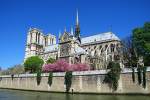 To experience one of the incredibly beautiful cathedrals in France, say, is to have a clue as to the devotion, faith, tenacity, and priorities of the people who had them built, and the pride they took in their work.
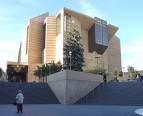
To alter a church on the theory that The Spirit of Vatican Two requires it is to try to seize the elusive winds of fashion.
Why adopt deconstructionism in church art...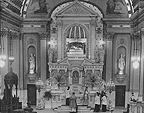
(St. Vibiana's altar in 1945, left; Our Lady of the Angels altar at its consecration, right.)
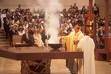
...just as a renewed appreciation for the finer things in life is reviving worldwide?
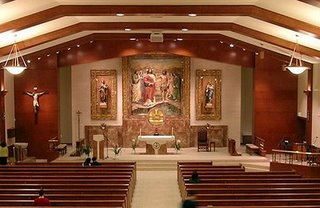
(St. John the Baptist, Costa Mesa; the stunning result of a renovation completed just this year [h/t Gerald; a commenter on the post wrote, "Wow! It's like someone at that parish suddenly woke up and said, 'Gee, we're not Protestants. Howz about we restore some grandeur and the promise of Mystery?'"] Gerald has been running a series of incredibly beautiful photographs of churches, by the way; do check them out.)
Simplicity can be beautiful, and inspiring:

(image from John Pawson Architecture, of the Novy Dvur Cistercian Monastery, Abbaye Notre-Dame de Sept-Fons; Czech Republic 2004.)
The austerity which arrests and focuses the attention can still overflow with beauty.
The Roman Catholic Church is known for her mysticism and her abundant and enduring contributions to the art of the Western world. We need to trust the generations before us which preserved timeless design principles, and let their contributions stand until we can understand them more clearly. To have new does not always mean the old must be destroyed. Truly brilliant design doesn't require that the old be destroyed to allow the new; nor does it compromise one for the other. Instead, it allows the two to mutually complement, support, and inform.

(Maybach image source)
JohnL then writes:
Mr. Bailey knew then what Virginia Postrel would later identify as the "aesthetic imperative." In Ms. Postrel's words:The Catholic Church - may God bless her abundantly - is far too monolithic to keep up with "trends." That's why, in some parishes, you can still hear 70s flower-child songs at Mass, played by guitars, instead of hip-hop and punk riffs. It's not wrong to let holy inspiration suggest new ideas about ways to celebrate in worship. What's wrong is to deny access the Latin Mass, Gregorian chant, and intricately carved altars, or to convince the laity that they were forbidden, which is essentially the same thing.Aesthetics--the look and feel of people, places, and things--is increasingly important as a source of value, both economic and cultural....
Aesthetics shows up where function used to be the only thing that mattered, from toilet brushes to business memos to computers and cell phones. And people's expectations keep rising. New tract homes have granite countertops, so hotel rooms have to have granite countertops too. Family restaurants used to be all about price and food, but now they have to worry about their decor. We've gone from Pizza Hut to California Pizza Kitchen. If you're in business, you have to invest in aesthetics simply to keep up with the competition. (emphasis mine)
We need both. I'm open to both. But I'm convinced that all Catholics have the right to experience their heritage, which includes the beauty and, yes, majesty, of liturgical art and music from prior ages in the Church.
The zeal of wreckovators to purge the Church of architecture of previous ages makes one wonder if their real reason is because what they're putting in its place is ... ? (tawdry and ineffectual? ... oops - did I say that out loud? shame on me!)
Beauty is not the enemy!
This Church is ancient. It is the original. We are told that to be old is to be out of date, worthless, not relevant; however, this Church was already ancient - over 100 years old - when Trajan took the Roman Empire to its maximum extent, 300 years before the Western Roman Empire would fall.
The Latin Mass - that arcane ritual which was tossed aside so casually 40 years ago - fed the spirituality of millions people for almost 2,000 years. If it was so inimical to faith, how did the Church manage to toddle along without the fresh ideas of those who didn't read (or dismissed as "not going far enough") the documents of the Council??
|| Memorandum ||
From: God
To: All who think the Catholic Church needs lots and lots
of busy tinkering with architecture, literature, philosophy, theology, et al.
_______________________________
Cool your jets.
YHWH:(various secretaries in His employ)
* * *
Two weeks ago I had the privilege of attending the Concours d'Elegance at Pebble Beach. This is considered the premiere event of its type in the United States.
You could say that it's all about old cars, and you'd be right. You hear people say lots of stuff about old cars. Like, old cars - who wants 'em? They don't have air conditioning. They aren't sensitive to the car seekers of today. The youth aren't interested. Young people would never show up to see old cars.
Oh yeah?
 (image found here)
How about an old car of such beauty and intrinsic worth that it has been restored from the ground up to its original beauty ... and even runs?

(image from Madle)
Yes, those are old cars. No, not everyone would want one at home. They are expensive to keep, etc. But, for car enthusiasts, they are the basics - like learning art history for an artist, or singing bel canto for a future opera star, or learning about roux for a future chef. To see these beautiful autos restored to their former glory - absolutely authentic, right down to the tires, which are specially made - is inspiring.
Those automobiles were built for fashion, of course; but they remain as icons because to experience them is to capture some of what it was to explore the possibilities of automotive transport. The art of their construction re-breathes ideas from prior years, while looking forward to the next. It is one thing to look at an image. It's another to see the sheer bulk of them, the gleam of chrome, the upholstery and appointments, and to hear the engine run. It is to understand what people felt when they bought and used cars in those days. It hearkens back to the history of motoring. Without those carefully-preserved automobiles, we would not have access to the experience.
Not much of a leap to think about how that applies to church architecture.
 To experience one of the incredibly beautiful cathedrals in France, say, is to have a clue as to the devotion, faith, tenacity, and priorities of the people who had them built, and the pride they took in their work.
To alter a church on the theory that The Spirit of Vatican Two requires it is to try to seize the elusive winds of fashion.
Why adopt deconstructionism in church art...

(St. Vibiana's altar in 1945, left; Our Lady of the Angels altar at its consecration, right.)
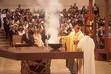
...just as a renewed appreciation for the finer things in life is reviving worldwide?
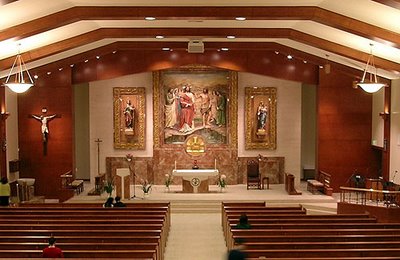
(St. John the Baptist, Costa Mesa; the stunning result of a renovation completed just this year [h/t Gerald; a commenter on the post wrote, "Wow! It's like someone at that parish suddenly woke up and said, 'Gee, we're not Protestants. Howz about we restore some grandeur and the promise of Mystery?'"] Gerald has been running a series of incredibly beautiful photographs of churches, by the way; do check them out.)
Simplicity can be beautiful, and inspiring:

(image from John Pawson Architecture, of the Novy Dvur Cistercian Monastery, Abbaye Notre-Dame de Sept-Fons; Czech Republic 2004.)
The austerity which arrests and focuses the attention can still overflow with beauty.
The Roman Catholic Church is known for her mysticism and her abundant and enduring contributions to the art of the Western world. We need to trust the generations before us which preserved timeless design principles, and let their contributions stand until we can understand them more clearly. To have new does not always mean the old must be destroyed. Truly brilliant design doesn't require that the old be destroyed to allow the new; nor does it compromise one for the other. Instead, it allows the two to mutually complement, support, and inform.

(Maybach image source)

26 August 2006
More on donor-conceived persons
Very thoughtful blog from Buffalo Girl. Found via Family Scholars, which has been running some posts about the topic.
It's so sad.
We seem to be in a time when the conclusions of those who think for a living and have carefully done research are either unknown, or disbelieved. We have torrents of news and noise coming at us via the airwaves and Internet, but one gets the idea that we're missing whole huge hunks of the wisdom we need to live fully this great life we've been given.
For example, there is a group that insists that:--
That seems like a perfectly reasonable statement. Unpopular, these days, but hardly the fruit of some half-baked ranting. Instead, it represents conclusions drawn after careful, slow consideration of all the aspects of the problem, moral, philosophical, physical, anthropologic ... but we refuse to listen. Instead of respecting the moral equivalent of "don't touch that stove or you'll get burned!", we stubbornly insist upon doing these things, rediscovering only later that there really are consequences:
* * *
The ones who defend the children's rights go on to show that they understand the fears and pain of those who resort to science to get children:
Parents have no right to a child.
The child has the right to be the fruit of the specific act of the conjugal love of his parents; and he also has the right to be respected as a person from the moment of his conception.
Not the kind of thing one hears about the topic these days. Magazines, doctors, and TV dramas all urge one to believe differently from those statements.
In charity, I suppose that many parents who resort to medical means of conception may never have encountered the alternative ideas about "best practices" for a whole, fully human, life.
Sadly, some parents are so focused on what they want that they completely forget that The Baby is going to be a human being, different from them, and complete with instincts and needs and desires which they've thwarted to fulfil their personal goals:
The child is not an object to which one has a right, nor can he be considered as an object of ownership: rather, a child is a gift, "the supreme gift" (58) and the most gratuitous gift of marriage, and is a living testimony of the mutual giving of his parents.
Read it all.
May God have mercy on those of us who have failed to trust our lives to God's love, and in our pride and ignorance have reached out to play with the pretty, warm flames.
And let us remember that a whole education does not consist of censorship; i.e., removing certain texts from the curriculum which have fallen out of favour with the current fads of thought. Instead, all the main schools of thought must be presented. Because, in the end, it's not some abstract thing we're dealing with, but life and our ability to live it well. Instead of thinking we know what we're doing - we who've had so little training in even how to think, much less what others have learned before us through centuries of observation and hard lessons - we need to get constructively lazy about life, and spend hours reading the thought of those who went before us, and respect that thought. We do not want to suffer the lack of children, so we take steps to avoid it, without having sufficient education or depth of thought to begin to imagine what it will do to those who bear the consequences of our actions:
It's so sad.
We seem to be in a time when the conclusions of those who think for a living and have carefully done research are either unknown, or disbelieved. We have torrents of news and noise coming at us via the airwaves and Internet, but one gets the idea that we're missing whole huge hunks of the wisdom we need to live fully this great life we've been given.
For example, there is a group that insists that:--
The child has the right to be conceived, carried in the womb, brought into the world and brought up within marriage: it is through the secure and recognized relationship to his own parents that the child can discover his own identity and achieve his own proper human development.(source)
That seems like a perfectly reasonable statement. Unpopular, these days, but hardly the fruit of some half-baked ranting. Instead, it represents conclusions drawn after careful, slow consideration of all the aspects of the problem, moral, philosophical, physical, anthropologic ... but we refuse to listen. Instead of respecting the moral equivalent of "don't touch that stove or you'll get burned!", we stubbornly insist upon doing these things, rediscovering only later that there really are consequences:
Just like the other six babies she has borne, this one will go home with a childless couple who paid Jill £12,000 in expenses to be their surrogate.
If her past experiences are anything to go by, Jill knows what is in store once her job is done.
She will return to her two-bedroom flat in Brighton, where she lives alone with three rescue cats, and cry her eyes out, telling herself that she is simply feeling hormonal and it's not the baby she weeps for.
--[snip]--
Jill's remarkable story can't help but raise some disquieting questions about the morality of surrogacy; questions those involved appear reluctant to confront.
In their desperate quest to become parents, do the childless couples who seek out women like Jill ever know just how emotionally needy or damaged they might be, or question their true motives? And if they do know, do they care enough to think twice about proceeding?
--quoted by Genevieve at feminine genius; source here.
* * *
“As I have said many times before and will say again, it does not matter how or why or for what outstandingly noble reason we were given away, back, forward or bloody sideways by our natural mums, it is still perceived by most as abandonment and there is a deep and unabiding loss.”(source) --Sara at Umbilicly_Challenged
The ones who defend the children's rights go on to show that they understand the fears and pain of those who resort to science to get children:
The suffering of spouses who cannot have children or who are afraid of bringing a handicapped child into the world is a suffering that everyone must understand and properly evaluate.It is understandable if one cannot agree with this stance; but it is reasonable, I think, to request that one seriously read and consider the statements and evaluate the reasoning behind them.
On the part of the spouses, the desire for a child is natural: it expresses the vocation to fatherhood and motherhood inscribed in conjugal love. This desire can be even stronger if the couple is affected by sterility which appears incurable. Nevertheless, marriage does not confer upon the spouses the right to have a child, but only the right to perform those natural acts which are per se ordered to procreation.(57) A true and proper right to a child would be contrary to the child's dignity and nature. The child is not an object to which one has a right, nor can he be considered as an object of ownership: rather, a child is a gift, "the supreme gift" (58) and the most gratuitous gift of marriage, and is a living testimony of the mutual giving of his parents. For this reason, the child has the right, as already mentioned, to be the fruit of the specific act of the conjugal love of his parents; and he also has the right to be respected as a person from the moment of his conception. (emphasis in the original.)
Parents have no right to a child.
The child has the right to be the fruit of the specific act of the conjugal love of his parents; and he also has the right to be respected as a person from the moment of his conception.
Not the kind of thing one hears about the topic these days. Magazines, doctors, and TV dramas all urge one to believe differently from those statements.
In charity, I suppose that many parents who resort to medical means of conception may never have encountered the alternative ideas about "best practices" for a whole, fully human, life.
Sadly, some parents are so focused on what they want that they completely forget that The Baby is going to be a human being, different from them, and complete with instincts and needs and desires which they've thwarted to fulfil their personal goals:
"Lets look at this from our point of view. Here is our biological mother our flesh and blood the woman who would naturally be raising and loving us totally denying that we are her child. I’m sorry but you just cant do that. We are your kids. We’re your kids just as much as your own kids, but yet you only think of us as some sloughed off egg that you are giving to a substitute mother who no matter how much love she has just can’t be the same as you? For 25 thousand dollars or whatever? You don’t bond with us when you are carrying us and you deny that we are yours because you have deluded yourselves and deny who and what we really are. That is so totally not right that I can’t believe anyone would think this is normal!And why are you doing this? For the most part its money from what I understand. Some of you have already admitted that in other posts. Would any of you do it if you did not get compensated for it? Or maybe if you didn’t get that feeling of belonging or acceptance that you never had as a kid? How do you think that makes us kids feel? You may be able to deny us but we don’t want to deny who you are. That makes us feel very rejected. That leaves a hole in our hearts whether we admit to it or it manifests some other way like in depression or a fear of getting close to someone else."--Brian
The child is not an object to which one has a right, nor can he be considered as an object of ownership: rather, a child is a gift, "the supreme gift" (58) and the most gratuitous gift of marriage, and is a living testimony of the mutual giving of his parents.
Read it all.
May God have mercy on those of us who have failed to trust our lives to God's love, and in our pride and ignorance have reached out to play with the pretty, warm flames.
And let us remember that a whole education does not consist of censorship; i.e., removing certain texts from the curriculum which have fallen out of favour with the current fads of thought. Instead, all the main schools of thought must be presented. Because, in the end, it's not some abstract thing we're dealing with, but life and our ability to live it well. Instead of thinking we know what we're doing - we who've had so little training in even how to think, much less what others have learned before us through centuries of observation and hard lessons - we need to get constructively lazy about life, and spend hours reading the thought of those who went before us, and respect that thought. We do not want to suffer the lack of children, so we take steps to avoid it, without having sufficient education or depth of thought to begin to imagine what it will do to those who bear the consequences of our actions:
I cannot control people's actions and I'm not trying to. In the end, people will find a way to justify their actions no matter what they do. I am just glad that there are people like you out there who wish to be more informed to make such a life-altering decision. Donors are not saving lives (of recipients), they are **creating** lives. Many people do not realize the intensity of the situation. My biological father is sick and tired of "the whole sperm donor thing" but it is my life. Though, in reality, it is irrelevant to any success or failure I will have but it is nothing less than significant to define my background, where I come from, and how I am treated, as something miraculous, taboo, unnatural, and medically supernatural.
No one knows better than donor-conceived people that blood does not make two people family... so why not save a life that is already on this earth and adopt?
...But that's just me.
--quoted in a post on the Buffalo Girl blog
25 August 2006
Touch
Via JoyfulWoman, I found my way to dancing on the ceiling and this meditation, which ends thus: --
They are not bound up with notions of being appropriate.
I've typed and deleted some paragraphs here. I'll leave it at this: if one doesn't care for touch, or sex, it is best - kindest - not to marry someone with an affectionate nature. ;)
People don't get touched enough. Many walk around with a bad case of skin hunger. There is something very attractive about people who live large and unapologetically. Their hearts show through. They are not bound up with notions of being appropriate. They are tuned into life. And I am all the richer for Sam and his hugs.
They are not bound up with notions of being appropriate.
I've typed and deleted some paragraphs here. I'll leave it at this: if one doesn't care for touch, or sex, it is best - kindest - not to marry someone with an affectionate nature. ;)
13 August 2006
Reformation ... or ruination?
This is a cogent, well-written article which had its inception in the current situation in the Episcopal church, but which repeatedly goes past that specific issue to show that it is part of a general trend away from the hard work of self-knowledge and repentance. Found via Drell's Descants.
12 August 2006
Thoughts on mothering
Over at Genevieve Kineke's feminine genius, there's a wonderful thoughtful piece about the mother who seems to pride herself in being unable to tolerate the common tasks of motherhood.
Genevieve writes,
Genevieve finishes with this:
It is not that mothers haven't felt this way at one time or another; for most, however, one can hope that it's a temporary state of mind, rather than something to write proudly about.
I don't think it's fair to pick on this mother. She's no philosopher. She reminds me of that line in the Deteriorata:--
While I read it, a word kept coming to mind: accedia. It's used to describe the state which sometimes descends upon monastics, but I think it can also apply to any of us in a vocation, even motherhood. However, as with most such states, the only way out is through. Dodging it, as the bored mother does, is often just a way to prolong one's needed soul-work.
I keep coming back to the idea that the bored mother was not mothered, herself... there's a lot to contemplate, there.
Dear God, please bless all mothers today, and particularly "love-bomb" that bored one. Bless her richly, Lord, as you know her heart. And, while you're working on her, please protect and guide her children. Amen.
Genevieve writes,
...she has a very good point. While mothers ooh and aah over many silly things for the sake of the child, there is the ubiquitous problem in our culture wherein the child is the centre of the universe and his ego is fed at the expense of teaching him authentic humility. Mothers are supposed to create a bridge between the child and his father, and ultimately between him and God the Father, Who says two things to each child simultaneously:When, after Genevieve considers some other aspects of it, she starts a new paragraph with:--
1. You are fearfully, wonderfully made and I adore you, My little creation; and
2. Repent! For you are dust, and to dust you shall return.
A good mother's love will allow the child to understand unconditional (undeserved) love while teaching him humility, concern for others, and a sense of purpose.
What this article screams between the lines is that this woman was not mothered....reading those words felt like a discovery. I wish she'd developed that thought more.
Genevieve finishes with this:
Her last defense shows her ignorance (despite a brilliant academic career):Tempus fugit, my dear. Love is all that lasts.All us bored mothers can take comfort from the fact that our children may yet turn out to be more balanced than those who are love-bombed from the day they are born.If she only knew what true love was, she would never dare drop a remark like this. She, the apple of God's eye, surrounded by the breath of the Spirit, and entrusted to the loving care of an attentive angel, heaps scorn on "love-bombing." Perhaps if she would stop obsessing about her own accomplishments and hourly self-fulfillment, she would find time to lift her head and give thanks -- for being love-bombed by the Almighty, Who saw fit to bless her with these two boys.
It is not that mothers haven't felt this way at one time or another; for most, however, one can hope that it's a temporary state of mind, rather than something to write proudly about.
I don't think it's fair to pick on this mother. She's no philosopher. She reminds me of that line in the Deteriorata:--
Be assured that a walk through the oceans of most souls would scarcely get your feet wet.Just because someone is "educated" does not mean they're wise, thoughtful or intelligent; in fact, it's a good bet that the more seriously they take their university degree, particularly in the liberal arts, the more likely it is that their natural sense of wonder and openness to simple joy is significantly, perhaps permanently, impaired.
While I read it, a word kept coming to mind: accedia. It's used to describe the state which sometimes descends upon monastics, but I think it can also apply to any of us in a vocation, even motherhood. However, as with most such states, the only way out is through. Dodging it, as the bored mother does, is often just a way to prolong one's needed soul-work.
I keep coming back to the idea that the bored mother was not mothered, herself... there's a lot to contemplate, there.
Dear God, please bless all mothers today, and particularly "love-bomb" that bored one. Bless her richly, Lord, as you know her heart. And, while you're working on her, please protect and guide her children. Amen.
The book meme
1. One book that changed your life:
Story of a Soul
2. One book that you've read more than once:
Little Women
3. One book you'd want on a desert island:
A blank one. (and a pen)
4.One book that made you laugh:
Diary of a Provincial Lady
5. One book that made you cry:
The Notebook
6. One book that you wish had been written:
The one I wrote that gave me a comfortable income for life. ;)
7. One book that you wish had never been written:
anything by Judy Blume
8. Two books you're currently reading:
Ship of Fools
Stranger in a Strange Land
9. One book you've been meaning to read:
The Spiritual Life
I tag my friend over at Happy Trails.
Story of a Soul
2. One book that you've read more than once:
Little Women
3. One book you'd want on a desert island:
A blank one. (and a pen)
4.One book that made you laugh:
Diary of a Provincial Lady
5. One book that made you cry:
The Notebook
6. One book that you wish had been written:
The one I wrote that gave me a comfortable income for life. ;)
7. One book that you wish had never been written:
anything by Judy Blume
8. Two books you're currently reading:
Ship of Fools
Stranger in a Strange Land
9. One book you've been meaning to read:
The Spiritual Life
I tag my friend over at Happy Trails.
09 August 2006
Stray thought...
...and not well thought-through, but this came into my mind this afternoon:
In the 60s and 70s, women were urged to get out of the kitchen and away from the home and demands of the family, and enter the workforce. Much of the rationale for it - not all, of course - was that women ought to do this, on principle, because they were "better" than just homemakers.
That principle is still cited today. Today in some circles one is considered rather odd if one considers one's calling to be homemaking.
Are we happier because of this? Are women truly fulfilled, demonstrably better off, clearly light years ahead of where they were?
Most women these days are more or less ignorant of what it takes to make a home. The FlyLady membership has topped 300,000 and is steadily growing. Many of us - and yes, I count myself among them - never learned the simplest techniques for taking care of a family. It isn't difficult; but there's nowhere to learn, these days. The concept of do it now, do a little bit, rest, balance, release perfection, etc. are all things many of our grandmothers knew and didn't even know they knew it. Now we have to rediscover it and learn it all over again.
What got me off on this kick was putting together my "control journal." This is a FlyLady thing. It means to write down one's routines, so as to stay on track throughout the week and get things done in little bits, instead of killing oneself trying to do it all on Saturday. I couldn't even grasp the concept for months and months; now I'm beginning to figure it out. So I wrote down my routines, morning and evening. The morning routine goes until 7:30, when I leave for work. The evening routine starts when I get home.
All of a sudden I realized that those hours in between were just - lost. I've never considered work part of my Life. It is a blank to me. I go in, I do my work, I go home. I have interesting, good work, for good pay, in lovely surroundings with great people. I earn my money fair and square. But, at the end of my life, when I look back over my time on earth, will I remember the days I spent at the office? Of course not.
I think doing anything out of principle, because someone just said you should, is a risky deal. And I think it's time for us women to take a long, hard, honest, unflinching look at what the feminists told us, and see if it really fits. Is it really what we want? Is it really who we are inside? We have a duty to ourselves, so that we can faithfully discharge our responsibilities towards our families and towards society. Society happens to need lots of well-adjusted, healthy, smart children. We are not being generous with our progeny. That is a serious thing, because we are putting ourselves and our fellow citizens at risk. Are we so incredibly happy, joyful, fulfilled, that it's a worthwhile trade-off, to stint on raising sound, happy families? Or are we getting a few hints from the weeping we cannot stop as we leave our newborns in the hands of others when we go to the office, or the anguish we feel as our empty-headed teenagers behave in ways we know are risky and will not bring them joy, happiness, or fulfillment?
We women have tremendous power. We knew this before, and we know it now. Do we have to blindly swallow the rhetoric of a bunch of women who wanted to tear apart society for their own ends?
What, exactly, is so wrong about devoting oneself to one's family, if that's what one's called to do? Should girls be taught to deny those yearnings to make a home and raise children because it's somehow more healthy to sit at a desk each day and go out to clubs at night?
Like I said, not thought-through, yet. And rather larger of a topic than I have time for tonight. I just think it's time for us to get brave and push back a bit against those who Know Better Than We What We Want.
Paul the apostle tells older women they should be guides for the younger ones. I think maybe that's true; we need to reflect seriously upon our lives, and help the young women around us to truly choose, not just reflexively do what they're told - by anyone.
In the 60s and 70s, women were urged to get out of the kitchen and away from the home and demands of the family, and enter the workforce. Much of the rationale for it - not all, of course - was that women ought to do this, on principle, because they were "better" than just homemakers.
That principle is still cited today. Today in some circles one is considered rather odd if one considers one's calling to be homemaking.
Are we happier because of this? Are women truly fulfilled, demonstrably better off, clearly light years ahead of where they were?
Most women these days are more or less ignorant of what it takes to make a home. The FlyLady membership has topped 300,000 and is steadily growing. Many of us - and yes, I count myself among them - never learned the simplest techniques for taking care of a family. It isn't difficult; but there's nowhere to learn, these days. The concept of do it now, do a little bit, rest, balance, release perfection, etc. are all things many of our grandmothers knew and didn't even know they knew it. Now we have to rediscover it and learn it all over again.
What got me off on this kick was putting together my "control journal." This is a FlyLady thing. It means to write down one's routines, so as to stay on track throughout the week and get things done in little bits, instead of killing oneself trying to do it all on Saturday. I couldn't even grasp the concept for months and months; now I'm beginning to figure it out. So I wrote down my routines, morning and evening. The morning routine goes until 7:30, when I leave for work. The evening routine starts when I get home.
All of a sudden I realized that those hours in between were just - lost. I've never considered work part of my Life. It is a blank to me. I go in, I do my work, I go home. I have interesting, good work, for good pay, in lovely surroundings with great people. I earn my money fair and square. But, at the end of my life, when I look back over my time on earth, will I remember the days I spent at the office? Of course not.
I think doing anything out of principle, because someone just said you should, is a risky deal. And I think it's time for us women to take a long, hard, honest, unflinching look at what the feminists told us, and see if it really fits. Is it really what we want? Is it really who we are inside? We have a duty to ourselves, so that we can faithfully discharge our responsibilities towards our families and towards society. Society happens to need lots of well-adjusted, healthy, smart children. We are not being generous with our progeny. That is a serious thing, because we are putting ourselves and our fellow citizens at risk. Are we so incredibly happy, joyful, fulfilled, that it's a worthwhile trade-off, to stint on raising sound, happy families? Or are we getting a few hints from the weeping we cannot stop as we leave our newborns in the hands of others when we go to the office, or the anguish we feel as our empty-headed teenagers behave in ways we know are risky and will not bring them joy, happiness, or fulfillment?
We women have tremendous power. We knew this before, and we know it now. Do we have to blindly swallow the rhetoric of a bunch of women who wanted to tear apart society for their own ends?
What, exactly, is so wrong about devoting oneself to one's family, if that's what one's called to do? Should girls be taught to deny those yearnings to make a home and raise children because it's somehow more healthy to sit at a desk each day and go out to clubs at night?
Like I said, not thought-through, yet. And rather larger of a topic than I have time for tonight. I just think it's time for us to get brave and push back a bit against those who Know Better Than We What We Want.
Paul the apostle tells older women they should be guides for the younger ones. I think maybe that's true; we need to reflect seriously upon our lives, and help the young women around us to truly choose, not just reflexively do what they're told - by anyone.
08 August 2006
In which naïve researchers "discover" some old news
I've been marveling over this article about how if kids listen to filthy song lyrics, they'll start having sex sooner. It's being reported as if it was a "discovery."
The reason it's news, I suppose, is that the strident voices of the 60s and 70s and 80s tried valiantly to convince themselves, us, school districts, etc. that kids aren't influenced one tiny bit by raunchy lyrics and R-rated films... just as you hear supposedly well-educated priests and liturgists say that there's nothing wrong with dumbing-down the words of the Mass or providing only dreck music.
Of course, they conveniently ignore or dismiss the fact that the economy rests largely upon people being gullible enough to march out like zombies and buy whatever's advertised on television...
Anyway... in the 60s, the assumption was that the parents were being "mean" and wanted to keep young people from having "fun" and "finding themselves," by trying to "hide" sex, etc.
It never occurred to the hormonally-challenged young that maybe - just maybe - the code of mystery and silence about sexual activity was not meant to blight their youthful existence, but was rather meant to help them make the most of their growing-up time. It's a lot easier to learn if you're not distracted by trying to do family-making behavior without the family to go along with it, and without the experience or wisdom or even enough knowledge to manage such a weird thing, anyway.
We natter on and on about "natural" foods, yet try to live in opposition to our instincts.
What's really sad is that a lot of kids have no idea what the alternative is. They don't know how to make a family, or be in a relationship. They're clueless about children, in a fog about finances, and totally without an original thought about history, politics, or any of the great books.
The parents and establishment of today is just as determined to keep the way of joy and wholeness from kids as previous generations worked so hard to shelter children from the brutality of a lawless, amoral world.
Perhaps this latest "discovery" will help the kids to wake up to what life can hold for them when they learn to really love, not just have sex... even if it's too late for their parents.
The reason it's news, I suppose, is that the strident voices of the 60s and 70s and 80s tried valiantly to convince themselves, us, school districts, etc. that kids aren't influenced one tiny bit by raunchy lyrics and R-rated films... just as you hear supposedly well-educated priests and liturgists say that there's nothing wrong with dumbing-down the words of the Mass or providing only dreck music.
Of course, they conveniently ignore or dismiss the fact that the economy rests largely upon people being gullible enough to march out like zombies and buy whatever's advertised on television...
Anyway... in the 60s, the assumption was that the parents were being "mean" and wanted to keep young people from having "fun" and "finding themselves," by trying to "hide" sex, etc.
It never occurred to the hormonally-challenged young that maybe - just maybe - the code of mystery and silence about sexual activity was not meant to blight their youthful existence, but was rather meant to help them make the most of their growing-up time. It's a lot easier to learn if you're not distracted by trying to do family-making behavior without the family to go along with it, and without the experience or wisdom or even enough knowledge to manage such a weird thing, anyway.
We natter on and on about "natural" foods, yet try to live in opposition to our instincts.
What's really sad is that a lot of kids have no idea what the alternative is. They don't know how to make a family, or be in a relationship. They're clueless about children, in a fog about finances, and totally without an original thought about history, politics, or any of the great books.
The parents and establishment of today is just as determined to keep the way of joy and wholeness from kids as previous generations worked so hard to shelter children from the brutality of a lawless, amoral world.
Perhaps this latest "discovery" will help the kids to wake up to what life can hold for them when they learn to really love, not just have sex... even if it's too late for their parents.
07 August 2006
Don't just tell ... show 'em what's going on?
Very interesting post via Quintero at L.A. Catholic, about a group of parishioners who recorded the liturgical abuses etc. on a CD and sent it around to some at the Vatican who might be interested.
According to the poster, it was helpful.
Such a presentation - simply letting the images and words speak for themselves - might be very enlightening to those who otherwise might dismiss such reports as exaggerated, simply because they're unfamiliar with the extent of the, ahem, creativity we're subjected to, because they're, you know, in Rome.
According to the poster, it was helpful.
Such a presentation - simply letting the images and words speak for themselves - might be very enlightening to those who otherwise might dismiss such reports as exaggerated, simply because they're unfamiliar with the extent of the, ahem, creativity we're subjected to, because they're, you know, in Rome.
05 August 2006
Last century's hangover
Bobbie at emerging sideways posted a link to this collection of old advertisements for various kinds of drugs.
She writes:

You see, my mother was prescribed medications to slow her fast-beating heart and calm her revved-up mind. Today we would call her condition "bipolar." Then she was just out of control, completely. She would talk a mile a minute ... for hours on end ... brilliantly, wittily, and with a streak of humour that would leave you sore and tired from laughing so hard ... but in the end, only tired, wishing she would just wind down and go to bed. She interpreted all such suggestions as personal slights, and got so extravagantly wounded by them that no one ever dared say anything like that again. Then ... whether from the drugs, or just the natural low point of the cycle ... she would sleep for days, drag herself to sit in front of her dressing table, smoking cigarettes, not eating, and barely able to take care of herself.
Life with her was never dull, I'll say that.
Anyway, all the doctors would do was prescribe phenobarbitol, and she took it lavishly and got so addicted that my father, in blind rage, brought her off of the stuff cold turkey one horrible week when I was very young (5? 6?). He could've killed her, doing that. All I remember was being taken upstairs to her room to see her. She was in her negligée, by the window, looking out, talking to "the chicken man" - the guy who delivered the "Chicken Delight" we sometimes had when she couldn't cook. I wasn't put off by that - my mother had a famous imagination, and told the very best stories - but by the attitude of my grandmother and the clear embarrassment of my father. He was always embarrassed by her. Come to think of it, she was perpetually embarrassed by him. It's really a wonder I'm here at all. ;)
Anyway ... I've been spared that particular horror in my life, though before Imitrex, I was prescribed extremely strong medicine to help me cope with the severe migraine I dealt with almost daily. I depended on the medicine and loved to feel it take hold, numbing the pain, allowing me to get through the day. Fortunately, I wasn't addicted.
But I, too, have my cycles ... a week of feeling great, then a week of illness and migraine... and, sometimes, I wonder ...
Bobbie was right, though: so many were medicated out of dealing with their griefs and sorrows and the natural adjustments of life - growing old, losing friends, etc. It was just another part of what contributed to the mess of the 60s and 70s.
And yet ... I once woke from surgery with the anesthetic completely worn off. I was still mostly paralyzed from the epidural, but I could hear and feel everything. I have never in my life felt such pain, and I hope to God I never do - that no one ever does. I lay in the bed whimpering "help me... help me..." while the nurses scurried around and prepared an injection of morphine. It was a relief beyond words to feel the stuff work its way up from my arm to my brain, so that the pain went away, and I could relax into the dark fog. So I'm not against drugs. But we cannot use them to escape the psychic work of growing and loss and grief and healing.
She writes:
this is a collection of vintage ads run in medical journals. some of these are terrifying to think of the lives ruined, the addiction created and the loss of dignity taken by medicine. i know they didn't know then what we know now, but it's still such a clue into how trying to anestitize a generation from their emotions and facing their past has brought us here. fascinating.I was fascinated by them myself, in the way one would be fascinated by the gun that was used to kill someone you loved... a morbid fascination, full of dread, afraid that if I look too long, the horrible things will reach out and grab my soul, too.

You see, my mother was prescribed medications to slow her fast-beating heart and calm her revved-up mind. Today we would call her condition "bipolar." Then she was just out of control, completely. She would talk a mile a minute ... for hours on end ... brilliantly, wittily, and with a streak of humour that would leave you sore and tired from laughing so hard ... but in the end, only tired, wishing she would just wind down and go to bed. She interpreted all such suggestions as personal slights, and got so extravagantly wounded by them that no one ever dared say anything like that again. Then ... whether from the drugs, or just the natural low point of the cycle ... she would sleep for days, drag herself to sit in front of her dressing table, smoking cigarettes, not eating, and barely able to take care of herself.
Life with her was never dull, I'll say that.
Anyway, all the doctors would do was prescribe phenobarbitol, and she took it lavishly and got so addicted that my father, in blind rage, brought her off of the stuff cold turkey one horrible week when I was very young (5? 6?). He could've killed her, doing that. All I remember was being taken upstairs to her room to see her. She was in her negligée, by the window, looking out, talking to "the chicken man" - the guy who delivered the "Chicken Delight" we sometimes had when she couldn't cook. I wasn't put off by that - my mother had a famous imagination, and told the very best stories - but by the attitude of my grandmother and the clear embarrassment of my father. He was always embarrassed by her. Come to think of it, she was perpetually embarrassed by him. It's really a wonder I'm here at all. ;)
Anyway ... I've been spared that particular horror in my life, though before Imitrex, I was prescribed extremely strong medicine to help me cope with the severe migraine I dealt with almost daily. I depended on the medicine and loved to feel it take hold, numbing the pain, allowing me to get through the day. Fortunately, I wasn't addicted.
But I, too, have my cycles ... a week of feeling great, then a week of illness and migraine... and, sometimes, I wonder ...
Bobbie was right, though: so many were medicated out of dealing with their griefs and sorrows and the natural adjustments of life - growing old, losing friends, etc. It was just another part of what contributed to the mess of the 60s and 70s.
And yet ... I once woke from surgery with the anesthetic completely worn off. I was still mostly paralyzed from the epidural, but I could hear and feel everything. I have never in my life felt such pain, and I hope to God I never do - that no one ever does. I lay in the bed whimpering "help me... help me..." while the nurses scurried around and prepared an injection of morphine. It was a relief beyond words to feel the stuff work its way up from my arm to my brain, so that the pain went away, and I could relax into the dark fog. So I'm not against drugs. But we cannot use them to escape the psychic work of growing and loss and grief and healing.
Subscribe to:
Posts (Atom)